5 ways to use garden planters (plus potscaping tips)
As I was photographing Diane and Robbie Perry’s garden in Kent, I admired the way they use garden planters to add punctuation and colour. They’ve used garden pots in five ways:
- To fill gaps in borders
- To frame a door or pathway
- Add colour where you want it
- To grow plants that you couldn’t grow in your soil
- Grouped together in a ‘potscape’ to create a big impact
Fill a gap in your border with a garden planter
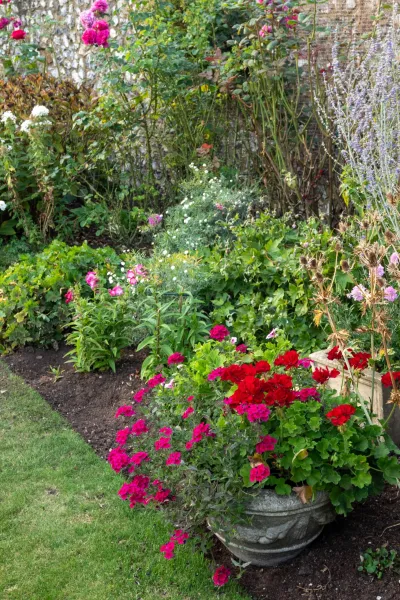
At the end of the summer, Diane says that gaps appear in her borders. Either she’s had to cut something back or the perennials are going over. And it’s too late to add anything to a herbaceous border, so she wedges in a pot or garden planter.
‘I use some old concrete planters which we inherited with the house,’ she says. ‘They disappear into the borders. It’s a good way of using less glamorous pots.’ She has added easy-to-find plants, such as pelargoniums to create the splash of colour.
Use your best garden planters to frame something
While Diane buries the less glamorous garden pots in the border, she invested more on the two main pots on either side of the front door. ‘It used to be a non-space,’ she says. ‘And it’s also quite narrow, so my options for big pots were limited.’
Use garden pots to add colour to your patio, terrace or border
Diane plans and re-plants her pots around twice a year – once for summer and once for winter. But as individual plants go over, she’ll replace them in between.
Changing or adding plants that are in flower now is a great way of adding colour, even if you have to change a couple of pots over every month.
Use pots for plants you find difficult to grow in the garden
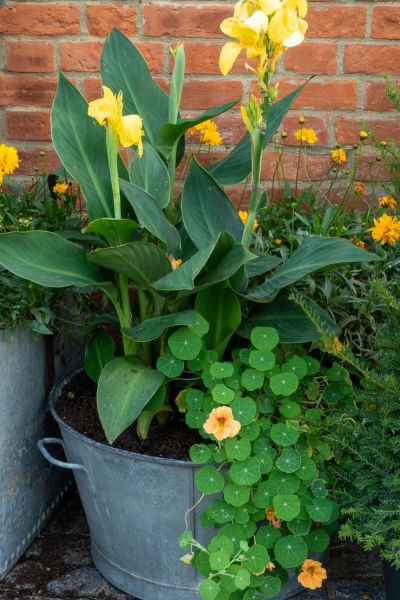
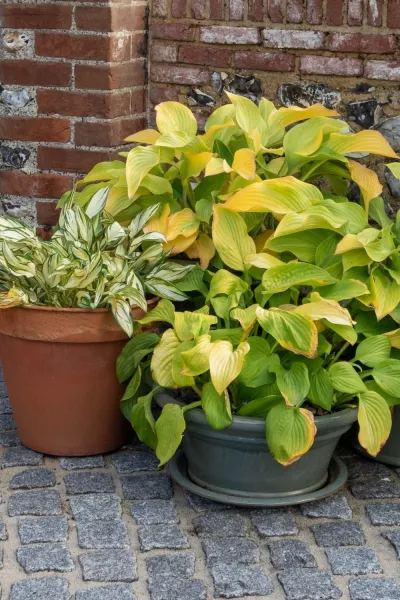
Many of us can’t grow hostas, except in pots. It’s easier – mostly – to keep slugs and snails away from hostas in pots than it is when they’re planted in the earth.
And garden planters are very useful for plants that need acid soil, such as rhododendrons, azaleas, skimmias, camellias and blue hydrangeas. It really is quite difficult to change the pH of your soil to grow these plants if they don’t grow well for you. Pots are the answer.
What is potscaping?
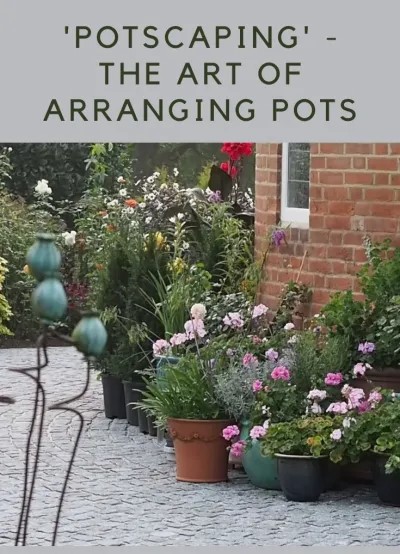
Potscaping is ‘landscaping for pots’, or arranging groups of pots in attractive ways.
Before I became a garden blogger, I wrote books about homes and interiors, such as ‘Upcycled Chic & Modern Hacks’ and ‘Thrifty Chic’. At the time, the words ‘tablescape’ and ‘mantelscape’ were just emerging, as people started to arrange their mantelpieces and tables for Instagram photos.
Note: links to Amazon are affiliate, so I may get a small fee if you buy, but I only recommend products I use myself (or wrote myself). And it doesn’t affect the price you pay.
But I digress. Back to potscaping. Diane groups her pots in similar blocks of colour. The terracotta pots are at one side of the potscape and the galvanized zinc on the other, with a few black plastic pots concealed in the general prettiness.
She starts with the larger pots at the back – mostly. Occasionally she brings one forward to provide vertical interest.
Diane advises you to add evergreen structure to your potscape. She has some conifer cones, which add a sculptural element and can stay in their pots for several years until they outgrow them. Then you can plant them in the garden.
Garden planter basics
If you want your garden planters to look beautiful almost all year round, then Diane recommends the following:
- Buy frost proof pots with good drainage
- Water your pots every day, but make sure you don’t over-water them. Some of Diane’s plants are in pot saucers. If the pot saucer fills with water then the plant is being over-watered.
- Feed your pots around twice a year. Plants in pots only have the nutrition you give them. They can’t get their roots down into the soil.
- Dead-head regularly and switch plants around once the flowers are over.
- You can reduce some of the work by mixing low maintenance plants with plants that offer beautiful flowers.
Shop my favourite garden products, tools and books
I’m often asked for recommendations, so I’ve put together lists of gardening books, tools and products I use myself on the Middlesized Garden Amazon store.