How to turn a wide shallow backyard into the perfect garden
I’m always being asked for ideas for breaking up the space in a shallow wide garden.
Many people also want to know how to make it look longer.
Many houses today are being built on small, individual plots. Gardens are getting smaller and they’re often shallow or odd wedge-shapes.
So I asked acclaimed garden designer Posy Gentles. She’s just done a brilliant garden makeover on a shallow wide garden in Whitstable.
How to design a shallow wide garden
- Create a brief. List everything you want to do in the garden
- Decide on your style
- Use trees, planting, sculpture etc in the centre to ‘interrupt’ the view to the back fence
- Divide the garden into thirds, going across
- Split the garden into zones – for plants, eating out, storage etc
- Use paths, borders or planting to mark out the zones
- Keep materials simple in a smaller space – use harmonious pavers and bricks.
- Decide on a colour scheme – use paint to marry everything together
- Create planting close to the house
The key to designing a wide shallow garden
The key to designing to designing a shallow wide garden is to stop your eyes from seeing the back fence immediately. You need planting, trees or something else in the middle of the garden.
Your eye will first see the trees, then it will look through them or past them to the back fence.
Because that process takes longer than just seeing a back fence in a fraction of a second, your brain is tricked into thinking that a short wide garden looks longer.
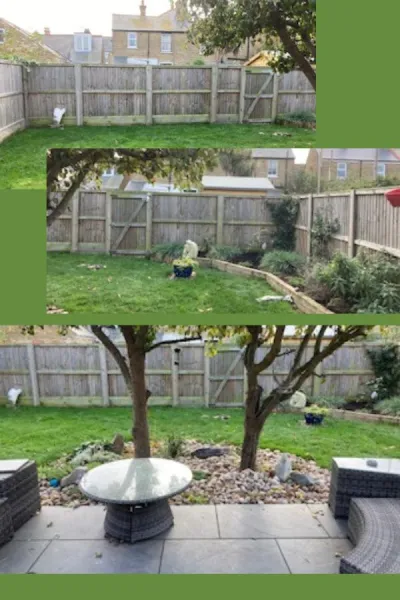
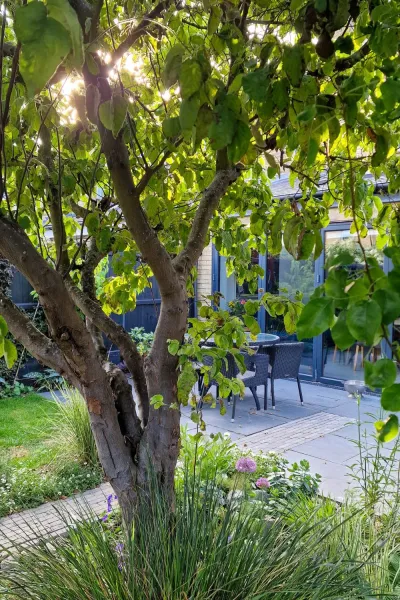
Luckily, Karen and Andrea’s garden had two beautiful mature fruit trees in the centre of the garden. ‘If they hadn’t been there, I’d have had to plant them,’ says Posy.
Some people put a border with planting or a sculpture at the centre.
How do you break up a shallow wide garden?
When Posy first saw Karen and Andrea’s garden, the garden was effectively split into half. One half was the terrace where they could eat or relax. The other half was the planting.
Posy decided to zone the garden into thirds – across the width. She reduced the size of the terrace by one paver,
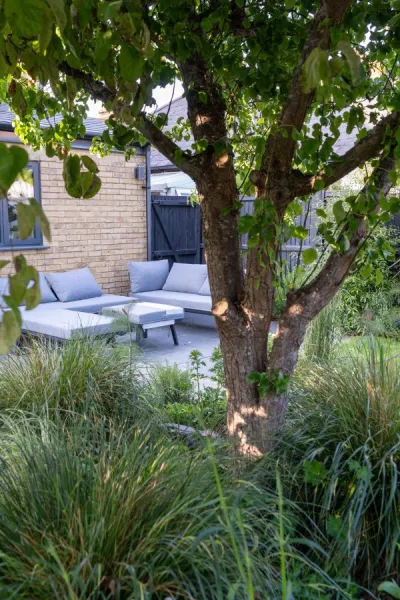
Instead of having all the eating and relaxing areas on one terrace, she created three separate groupings of seating and tables in three of the four corners of the garden. She moved the shed into the fourth corner.
This creates a ‘journey’, which once again blurs the true size and shape of the garden. ‘You go down one path and round some shrubs, then you find the sunny corner of the garden for evening drinks,’ says Posy. ‘If you go down the other path, you get to the shed and storage area.’
You can split or zone a garden using paths, borders or hedges. Posy decided to use a brick path in a similar shade to the pavers on the terrace.
Very cleverly, she took this path down either side of the garden and right into the terrace. This links the path and terrace visually.
Keep materials simple, especially in smaller gardens
For the paths, Posy chose a brick that nearly matched the terrace’s slate pavers. She also had the path cut into the terrace, to link it visually.
This is a good designer tip for most smaller spaces. In this post about designing a long thin garden, owners Mel and Emma have chosen harmonious, bleached-out materials for their fence, path and greenhouse.
And leading international garden designer Paul Bangay links the different parts of his garden by using one attractive shade of blue paint for gates, furniture and fences.
Paint the fence dark to make it ‘recede’
Posy had both the fence and the shed painted in a dark colour to make them ‘recede’. The shed almost disappears into the fence visually now, rather than sticking out as it had done previously.
She picked the same colour as the window frames on the house – anthracite, which is almost black. Once again, if it’s a small space, think carefully about how the colours work together and how they work with the house. Keeping it simple makes it feel more spacious.
Planting ideas for wide gardens
When Posy first saw this garden, there was a raised border at the other end of the garden. However, Posy started the planting at the edge of the terrace. It’s close to the house and also close to the various seating areas. ‘You want to feel that you’re in the garden,’ she says.
You don’t need special plants for wide gardens. When you’re planning the planting, choose the plants you love. If you have a big herbaceous border, follow Posy’s advice and run it close to the house and across the garden. There will be wonderful colour and interest directly outside your windows.
When you’re looking for creative ideas for your wide shallow garden space, always think about how you are going to use the garden. Before you decide what hard landscaping you want, take a picnic chair and table outside and experiment with sitting in different places.
If you have a very small wide garden, then Posy suggests that you divide it into a place to sit and planting. ‘Once again, it’s effectively dividing the garden up into thirds, with a border on either side of the seating area, plus planting at the back. And include some larger plants.’
