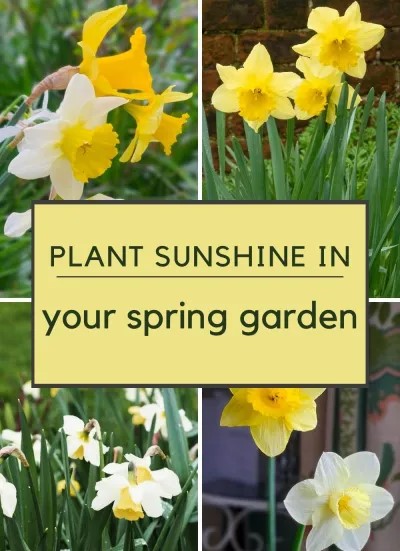
How to grow daffodils for years of beautiful spring flowers
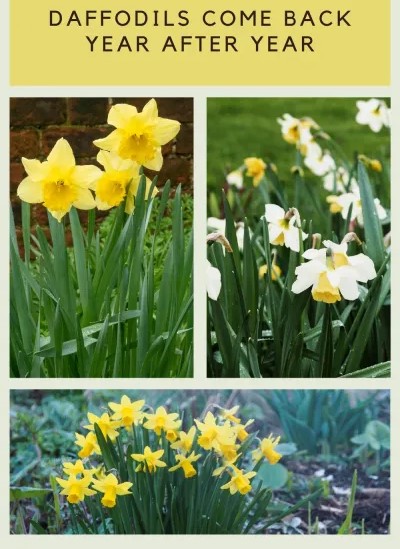
If you grow daffodils, they’ll come back year after year.
Tulips are outrageously colourful and gorgeous, but usually disappear after one or two years. Daffodils are the most easy-going spring flowering bulbs. Not only do they come back, they will often spread.
Daffodils are also considered to be deer, squirrel, rodent and rabbit-proof. (Although old hands will say that some deer, squirrels or rabbits will eat anything!)
I’ve researched tips from the professionals who grow bulbs for a living. And I found that the advice on how to grow daffodils has changed over the years. If you’re still planting bulbs with fertilizer or adding gravel ‘to improve drainage’, read on. Growing daffodils is even easier than you think.
Where do daffodils grow?
Daffodils grow in a wide range of climates – they can withstand winters down to minus 20C/minus 4F!
But they won’t grow in very warm climates. So if you never need to wear a winter coat, you probably can’t grow daffodils!
And daffodils are happy in almost any kind of soil – as long as it’s not really wet. Plant daffodils in pots if you have lots of rain.
All the major bulb suppliers have ‘how to plant daffodils’ instructions. As they plant and grow daffodils for a living, I’d say they have the most accurate and up to date information, so this post pulls together advice from de Jager, Bloms Bulbs, Peter Nyssen, Farmer Gracy, Sarah Raven, Crocus, Gee Tee Bulbs, Thompson & Morgan and Avon Bulbs.
The people who have grown daffodils for decades know what works and what doesn’t.
What’s the difference between daffodils and narcissi?
There isn’t a difference. Daffodil is the common name and narcissus is the botanical name for the same plant.
But sometimes growers call some of them ‘daffodils’ and some ‘narcissi’ when labelling them for sale.
What are the best daffodil varieties?
There are so many different daffodils, but there’s no ‘best daffodil variety.’ It depends on what you want your daffodils for.
If you want a long period of flowering, divide them up into early and later flowering varieties. Many bulb suppliers will do a collection with a range of flowering times.
Or perhaps you want daffodils for the vase? Many growers, such as Sarah Raven, will recommend specific daffodils that are best as cut flowers.
You may want daffodils for the lawn or daffodils that will spread easily. Look for ‘bulbs that naturalise’.
When you receive your daffodils…
All the specialist bulb growers said you should plant your daffodil bulbs as soon as you get them. If you can’t do that, then take them out of their plastic bags and store them somewhere cool and dark until you can plant them.
If you leave them in a plastic bag, they’re more likely to rot or grow mouldy.
When to plant daffodil bulbs?
Plant your daffodil bulbs when the weather cools down, after the end of summer and before the ground freezes.
Autumn or fall are considered to be the best time for planting daffodils. Here in the UK, where we rarely have snow, I have planted daffodils throughout the winter and up until the beginning of spring.
But if you regularly have snow or your ground freezes, you’ll need to plant your daffodils in autumn/fall.
If you find a bag of daffodil bulbs that you forgot to plant, just plant them, even in early spring. They may not flower – but they definitely won’t flower if you leave them in the bag. And they will probably rot!
Where can you grow daffodils?
Daffodils are happy in sun or partial shade and in a wide variety of soils. But they don’t like being really wet.
They’re very cold hardy, so can take very severe winters, down to minus 20C/ minus 4F and sometimes even colder.
However, they won’t be happy in warmer countries. Daffodils grow well in the UK, Northern Europe, the Northern part of America and the southern, cooler parts of Australia, but there are fewer varieties for warmer areas like Florida.
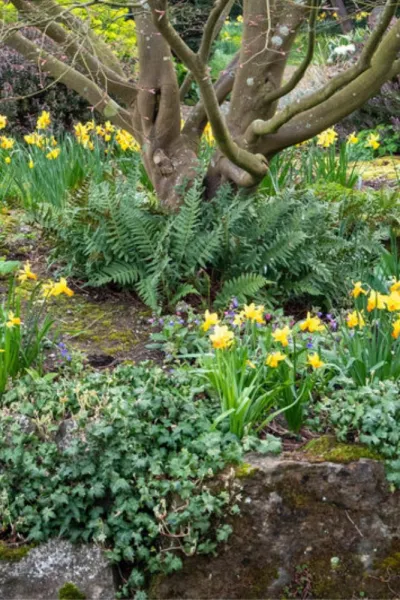
Daffodils grow well next to deciduous trees and shrubs, because their leaves are off in the winter. But there is general agreement that they may not flower so well if very shaded by evergreen trees and shrubs.
How to plant daffodil bulbs
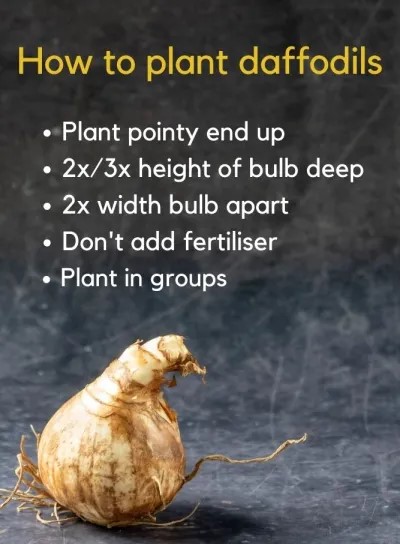
Firstly, always plant daffodil bulbs with the pointy end upwards.
Most bulb growers recommend planting bulbs at a depth that is three times the height of the bulb. Some said 2x or 4x the height of the bulb, and most said leave 10cm-15cm of soil above the bulb. There’s not a huge difference between these different measurements, so 3x the height of the bulb seems a safe one to go for.
Most recommended that you plant daffodil bulbs between 2″/5cm and 6″/15cm apart. The RHS says plant bulbs twice their width apart. You can plant smaller bulbs closer than larger ones.
The most common recommendation was to plant daffodils about 4″/10cm apart, but experiment if you prefer the look of them a little further apart or closer together. Most daffodils will spread, so they should grow closer together with time.
How to arrange daffodil bulbs when planting
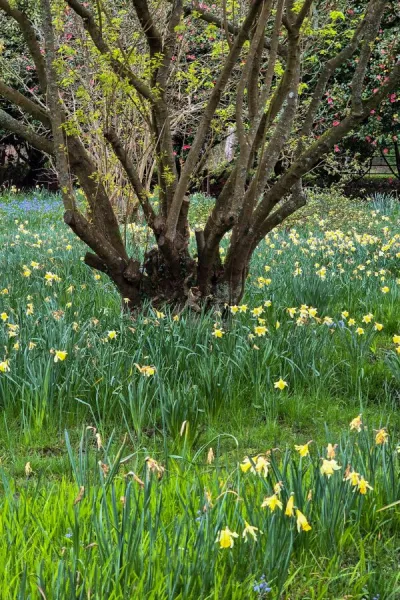
Don’t plant daffodils in neat rows. They look best in groups in borders. If planting in grass, throw handful of bulbs lightly across and plant where they land. That looks natural.
If you’re planting in a border, dig a hole or trench so that you can plant 5,7 or 9 bulbs in one hole. Then cover them up with soil.
Until recently, I simply used a narrow trowel to make individual holes for bulb planting, but I’ve now bought a long handled Spear & Jackson bulb planter.
If you’re planting daffodils in grass, use a bulb planter because it will take a small plug of soil and grass out. You then drop the bulb in, and pop the soil and grass plug back on top.
Some people prefer planting bulbs with an auger, which is a spiral blade for a power drill. If you use power tools, then it makes bulb planting very quick.
When should you fertilize daffodils?
Don’t add fertilizer when you plant daffodils.
Many posts on daffodils say that you should add a slow release fertilizer when planting bulbs.
But none of the specialist bulb growers I checked recommend it!
It’s particularly important not to fertilize bulbs when you plant them in the lawn. The fertilizer will be used up by the lawn grass, which will grow thicker and more dense. If you’re trying to encourage wild flowers in a lawn, fertilizer will make the grass too strong.
If you want to improve the soil, add garden compost or well rotted manure, either in the hole when planting or in a layer on the soil.
Bulbs have got everything they need for next year’s flowering in the bulb when you plant it. Adding fertilizer to the planting hole won’t affect that flowering.
Fertilize daffodils during or after flowering
Once the green leaves grow in spring, the bulbs start to use their store of nutrition up. They will indeed want more nutrition for next year’s bulb.
However, if you added a slow release fertilizer when you planted the bulb, it will probably have mostly washed away by the time the leaves emerge.
Here it’s worth clarifying the difference between garden compost/mulch and fertilizer.
Fertilizer is directed at a specific plant, but doesn’t improve the fertility of the soil as a whole. Garden compost and mulches, such as well rotted manure, improve the soil’s general fertility. If you add a layer to your soil at least once a year, you’ll help all your plants, not just your bulbs.
Recommendations vary on how and when to feed bulbs in the spring, but there seemed to be general agreement that a liquid seaweed or comfrey feed just before, after or around the time of flowering will benefit the bulb.
But you don’t always have to use fertilizer when you grow daffodils. Many people just leave their daffodils to get on with it. The flowers continue to come up year after year. So I think fertilizing daffodils is probably for those who want to maximise their flowering
Several growers specifically advised against adding fertilizer to daffodils in a lawn. They said that fertilizing daffodils in a lawn will feed the grass more than the daffodils.
Do you need to water daffodils over the winter?
When you plant daffodils, most growers recommended watering the area once you’ve covered up them up with soil. But all say that there’s no need for further watering over the winter.
However, once the green leaves emerge in spring, some sites recommend watering, if the weather is unusually dry.
Some springs are very dry here in South East England. I don’t water my bulbs. The daffodils are usually fine, but in a very dry spring, the tulips come out much shorter and smaller than expected.
The bulbs I watered were all taller and bigger than the ones I didn’t water.
All growers emphasised that too much water can cause daffodils to rot. So it’s probably safer not to water daffodils over winter.
What do I do with daffodils after flowering?
Every single gardening expert says that you must leave daffodil leaves for around six weeks after the plant has flowered.
Even if they have started to go a little yellow, leave them until they have died back completely.
The plants need their leaves. They are making your daffodil flowers for next year.
And never tie the leaves up in knots – it used to be a fashion, but it also interferes with photosynthesis. That means you are preventing the plant from making the best possible flowers for next year.
Even if you are going to dig your daffodil bulbs up to store them, you must wait until the leaves have died back.
As the daffodil leaves die back, other plants in the garden will be emerging, so it shouldn’t look too bad.
What happens if you don’t deadhead daffodils?
They’ll be fine. I rarely deadhead my daffodils and they bloom year after year.
If you want the best possible blooms, then deadhead your daffodils when the flowers die. Then add a liquid seaweed or other fertilizer.
But if you don’t have time, you should still get a good display next year.
Do daffodil bulbs need to be dug up?
You can leave daffodil bulbs in the ground indefinitely.
In major gardens that are open to the public, they are often dug up in order to maximise the growing space for later plants.
But personally I find that many plants will grow happily around the daffodil bulbs, which disappear underground by early summer.
If you are going to store them, let them dry and store them in a cool dark place with enough ventilation. Don’t put them in a plastic bag as they will rot.
Personally I find storing bulbs is more difficult than leaving them in the ground.
Why aren’t my daffodils flowering?
The two main reasons are that they have been planted too shallow or that they don’t get enough sun, according to all the bulb growers.
And if you cut the leaves off early last year, then that can prevent them flowering this year.
Sometimes daffodils ‘go blind’ and don’t flower at all. There are various remedies suggested for this, but many gardeners I know say that they don’t often work. You’d be better off digging them up, throwing them away and planting new daffodils.
Tulips in pots can create glorious displays and are much easier than tulips in the ground.