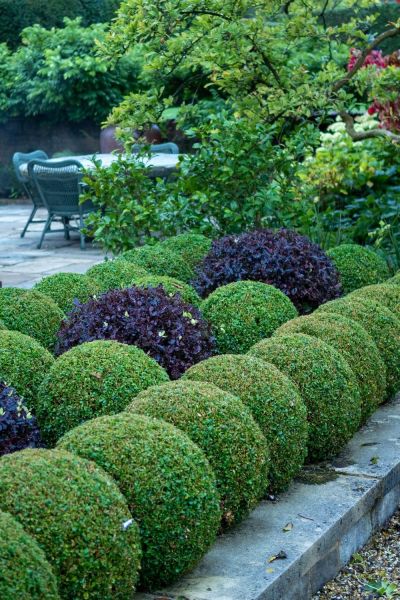
The three best alternatives to box for simple topiary
There are only a few good alternatives to box (English boxwood or Buxus sempervirens) for topiary.
And I have just visited a delightful private garden in Kent which shows off both box and the best box substitutes absolutely beautifully.
Box has two problems. One is box blight and the other is box tree moth caterpillar. The box caterpillar is spreading particularly fast. You may have seen dead and dying box plants in gardens where you live. And many garden designers now avoid using box at all.
Even if you don’t have box blight or box tree caterpillar where you live, there are great advantages to finding alternatives to box for your topiary and low hedging structure.
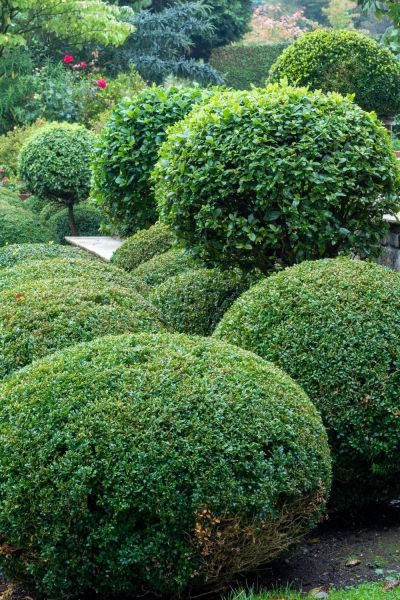
Firstly, the different leaf colours make for excellent foliage contrast, as you can see below (and above!). Good foliage contrast can make your topiary and evergreen shrubs stand out.

And secondly, if a pest or disease does come along, a good mix of different shrubs will help stop the spread. Having lots of the same plant in one garden can mean that one pest or disease can devastate the garden. Diversity is the key to good health.
This beautiful private garden has been planted with lots of box topiary over the years. And it’s had a brief brush with both box blight and the box tree caterpillar.
But Jim has got it under control, partly by finding alternatives to box and partly by treating the few affected plants they did have.
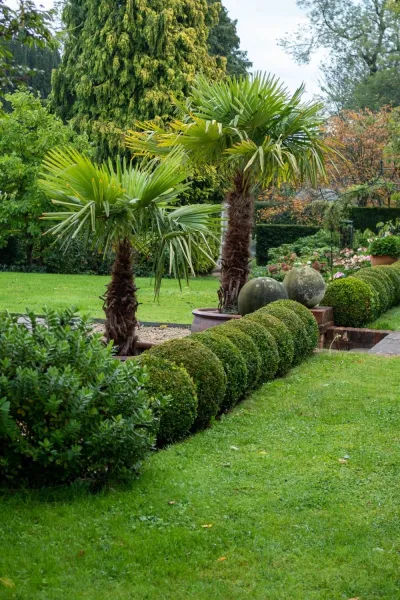
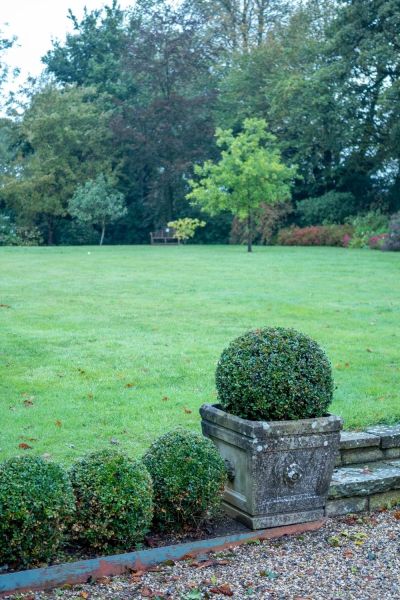
What plants are good alternatives to box for topiary and clipped hedging?
- Yew – the number one alternative to box
- Pittosporum – tender in colder winters
- Euonymus (Euonymus japonicus) – good for foliage contrast
- Viburnum tinus – rounded shapes only
- Privet – fast growing so needs clipping regularly
- Holly, including Ilex crenata (with warnings…)
How do I know if I’ve got box moth caterpillar?
Box moth caterpillar is also called box tree moth caterpillar or just plain ‘box caterpillar’. They’re all the same!
You’ll see brown patches of dead leaves in your box plant. Look closer and you will also see fine, white spider-web type webbing, and green caterpillars with a yellow stripe.
Often the whole box plant dies.
Is yew a good alternative to box?
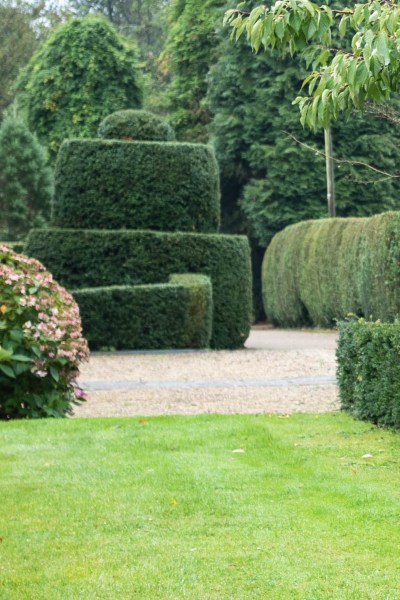
Jim says that yew (Taxus baccata) is by far the best alternative to box for topiary and low hedges. ‘People think of it for grand gardens and big hedges,’ he says. ‘But it can be cut quite low and into any shape you want. You can prune it as hard as you like and it will grow in any soil. It doesn’t like its roots sitting in wet soil, but otherwise it’s very robust.’
If you want vertical shapes, he recommends Irish yew, which is grows up in a narrow, tight fastigiate column. If you want balls, spirals, boxes or low hedging, then buy English yew.

Tips on buying yew plants
Jim recommends buying root-balled yews at least 60cm-80cm tall. Root-balled means they are dug up from the field, with soil around their roots. They are wrapped in some kind of sacking or similar material. Cut them back when you have planted them if you want them shorter. ‘For some reason, planting pot grown yews under 60cm often has a high failure rate,’ he says.
Pittosporum – good for foliage contrasts
‘If you want large topiary balls, I’d choose pittosporum,’ says Jim. ‘It’s another fantastic evergreen plant. It doesn’t have many pests or diseases – just occasional leaf spot which can be treated very easily.’
You can prune pittosporum back hard and it’s drought tolerant. ‘However, it is quite vigorous,’ he says. ‘You can clip box once a year, preferably in July/August so that new growth hardens off before the frosts. But yew and pittosporum both need clipping twice a year, in spring and autumn.’


When buying pittosporum, Jim recommends you check that the plant isn’t pot bound. Slip it out of its pot to make sure that the roots haven’t formed a tight mat against the side of the pot. This is called ‘pot bound’ and pot bound plants often fail to thrive as their roots don’t spread out into the soil in the right way.
Pittosporums can also be slightly frost tender, so don’t plant them in a frost pocket. If you have a hard frost forecast, Jim recommends that you throw a horticultural fleece over them.
Pittosporum also emerged well in the RHS trials of alternatives to box. However the reports from the RHS Garden Wisley warn that pittosporum is not hardy in winters below minus 8C/17F. So pittosporum isn’t an option if you have cold winters!
Podocarpus also emerged well out of the RHS Garden Wisley trials. It, too, can be somewhat frost-sensitive, although it’s usually fine in most UK winters and USDA zones 8-11. That means it tolerates temperatures a few degrees below zero, but probably wouldn’t survive a long, harsh, snowy winter.
Alternatives to box – Euonymus also good for foliage contrast
Euonymus (Euonymus japonicus) is the third best alternative to box, says Jim. Like Pittosporum, it comes in a number of different varieties with shades from grey-green to yellow-green.
Think about the importance of foliage contrast when you’re choosing alternatives to box. Euonymus comes in a range of colours from silvery-white to golden greeny-yellows.
Euonymus japonicus tend to be pest and disease-free, says Jim. But they can lose their leaves in very cold winters, although they re-grow again the following spring. It’s a slow growing plant and will take a little time to form into a low hedge or shape.
Three alternatives to box you may want to avoid
There are three other evergreen shrubs that can work as alternatives to box for simple topiary. But Jim has reservations about them.
Japanese holly (Ilex crenata)
Firstly, Japanese holly (Ilex crenata) has often been recommended for topiary, because it looks so like box. It has small leaves and can be clipped into shapes. But Jim says that he finds that it has a looser habit. ‘You won’t get the tight, compact topiary you would get from yew or box.’
It doesn’t thrive in this garden, although it’s supposed to do well in any soil. Jim says that it’s also quite expensive, so personally he wouldn’t buy it again.
Early results of trials at the RHS Garden Wisley confirm that Japanese holly/Ilex crenata isn’t as good a substitute for box as everyone hoped. that may be because the RHS Garden has sandy soil, but other gardeners I’ve spoken to have also been disappointed.
Privet (Ligustrum ovalifolium) –
Secondly, privet (Ligustrum ovalifolium) can be clipped into shape. I’ve got two privet lollipops in my garden and they are a very affordable way of having topiary.
But Jim warns that privet is very fast-growing, so you would need to clip it three times a year. I agree with him. It’s fine for me to clip two little standards three times a year, but if I had any more privet it would be too high maintenance.
Privet isn’t completely evergreen. In harsh winters, it can lose a lot of leaves. They come back in spring, but can look quite bare for months.
Viburnum tinus
The third evergreen shrub often recommended as an alternative to box is Viburnum tinus. You can see it in the picture below by the steps. It looks great clipped into lollipop shapes. But Jim says that it is only good for a rounded shape and couldn’t be clipped into cones or spirals.
Clipped shapes and contrasting foliage in a conifer hedge!
Conifers, such as Leylandii cypress, can offer good evergreen shapes. They are fast-growing, so you will have to keep clipping them regularly.
There is a clipped conifer hedge in this garden which is made of two conifers with contrasting foliage colours. It looks so stylish!
The main run of the hedge is Cypress Leylandii, kept clipped regularly to stop it from getting out of control. Then there are columns of Thuja occidentalis, which has a paler green foliage, planted in front of the main hedge. These are also clipped to shape.


I’ve seen another private garden using this technique with conifers, with an even greater contrast in colour. It’s a garden that is mainly planted with evergreen shrubs and trees, so it has lots more inspiration for creating an evergreen garden for year round interest.

Is topiary expensive?
Large topiary items are expensive. They can cost thousands just for one plant.
But it’s not too difficult to cut shrubs and trees into shape yourself and that will save lots of money. If you’re prepared to ‘grow your own’, you can achieve very similar effects at an affordable price. I have lots of topiary in my own garden.
My friends, Robbie and Diane Perry have also created a stunning topiary garden.
Growing topiary yourself takes time, which is why buying big topiary pieces costs so much. But in 3-5 years, you can create really dramatic effects of your own.
Treatments for box blight and box moth caterpillar
If you want to avoid box blight, make sure you buy your box from specialist, preferably local suppliers who know they haven’t got it. Or grow your own from cuttings. Never borrow other people’s shears or other equipment.
But as the box tree moth caterpillar can fly, these measures are less effective against it.
You can buy effective chemical treatments against both box blight and box tree moth caterpillar/box caterpillar. But the most effective treatments need a licence. So amateur gardeners generally don’t have access to these.
Many amateur gardeners use treatments based on a biological formula using Bacillus thuringiensis. This is considered safe for birds, bees and the environment. It’s widely used in many countries and is available by mail order under the name Xantari. However it is not yet licensed for sale in the UK so you would have to buy it from abroad via Amazon.
Jim has a licence, so he uses a pesticide called Bandu against the caterpillar and a fungicide called Signum against the blight.
