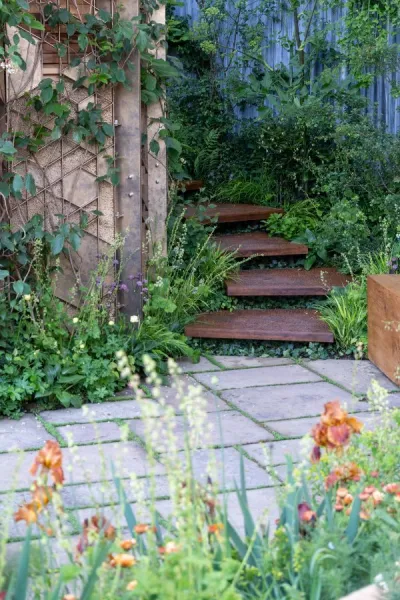
8 inspiring ideas for your garden from the RHS Chelsea 2024
Over 150,000 people visited the RHS Chelsea Flower Show in 2026. They saw show gardens built with budgets over £300,000 each. Most left wondering: how do I do any of this in my 6x4m patch?
You can. The best Chelsea trends are not about money. They are about thinking differently. Here are eight ideas from the 2026 show that translate directly to a normal garden, with no landscape architect required.
1. The main trend: naturalistic planting that survives neglect
The single biggest shift at Chelsea 2026 was a move away from manicured borders. Designers like Tom Stuart-Smith and the team behind the National Garden Scheme Garden used perennials that look good when they flop, seed, and die back. This is not laziness. It is ecology.
Naturalistic planting uses plants that evolved in your climate. They need less water, less fertilizer, and almost no staking. The key is choosing the right structural plants and letting them self-sow.
| Plant type | Example from Chelsea 2026 | Why it works at home |
|---|---|---|
| Structural grass | Stipa gigantea (golden oat grass) | 2m tall, flowers for 6 weeks, needs zero water after year one |
| Seed-head perennial | Echinacea purpurea ‘White Swan’ | Flowers July–October, seed heads feed birds in winter |
| Ground-cover filler | Geranium ‘Rozanne’ | Blooms May–November, smothers weeds, spreads 1m wide |
| Self-sowing annual | Nigella damascena (love-in-a-mist) | Seeds itself freely, fills gaps for free every year |
The failure mode: Most people buy plants that look good in June but collapse by August. Naturalistic gardens look best from July to October. If you want a perfect May border, this is not for you. Stick to traditional herbaceous perennials and accept the extra work.
How to start a naturalistic border at home
Pick one 2x2m area. Remove all weeds. Add a 5cm layer of grit or gravel on top of the soil. Plant in groups of 3, 5, or 7 — never singles. Water deeply once a week for the first summer. After that, stop watering entirely. The plants that survive are the ones that belong.
This is exactly what the RHS Chelsea 2026 Sanctuary Garden demonstrated: a gravel garden with no irrigation after establishment. It worked because the plants — Stipa, Echinacea, Sedum, Verbena bonariensis — are drought-tolerant by nature.
2. Water features that filter themselves
Forget the plastic pond liner and the pump that clogs every autumn. The Chelsea 2026 show gardens used self-contained recirculating water features with built-in biological filtration. The WaterAid Garden featured a shallow rill that looked like a stream but was actually a closed loop with a submerged pump and a planted biofilter.
You can build this in a weekend. Buy a 60x40cm galvanized steel trough from a farm supply store. Add a small submersible pump (flow rate 500L/hour, costs about £25). Run the water over a layer of pebbles and Juncus effusus (soft rush) planted in aquatic compost. The plants filter the water. You top it up once a week. No chemicals. No electricity beyond the pump.
The mistake most people make: They buy a pre-formed plastic pond and try to make it look natural. It never does. A clean-lined metal trough or a stone basin looks deliberate. It fits a modern or cottage garden equally well.
The RHS Chelsea 2026 Feels Like Home Garden used a simple black basin with a single fountain jet. Total cost for the water feature: about £150. The sound of running water masks traffic noise and attracts birds within days.
3. Shade planting that isn’t boring
Shade gardens at Chelsea 2026 were not dark and gloomy. The RHS Chelsea 2026 Shade Garden (designed by Ann-Marie Powell) proved that shade can be vibrant. The trick is layering foliage textures and using bright white or yellow flowers that pop against dark green.
Three plants that appeared in multiple show gardens for shade:
- Dryopteris filix-mas (male fern) — architectural fronds, evergreen, thrives in dry shade under trees
- Hosta ‘June’ — blue-green leaves with yellow centres, slug-resistant variety, flowers in July
- Tiarella ‘Spring Symphony’ — foamy white flowers in May, spreads to form a ground cover, works in deep shade
When not to plant shade perennials: If your shade is caused by a north-facing wall with dry soil (the classic “rain shadow” problem), most ferns and hostas will struggle. In that situation, use Euphorbia amygdaloides var. robbiae (Mrs Robb’s bonnet) — it thrives in dry, dark conditions and spreads vigorously. Plant it with a 5cm layer of leaf mould on top of the soil, and it will need no watering after year one.
The RHS Chelsea 2026 Shade Garden also used pale grey gravel as a mulch. It reflected light upwards into the foliage, making the whole border feel brighter. You can do the same with any light-coloured stone chipping.
4. The gravel garden: less lawn, more life
The RHS Chelsea 2026 Gravel Garden (part of the World Wildlife Fund garden) replaced turf with a 10cm layer of 20mm gravel over a weed membrane. Into this gravel, they planted Allium sphaerocephalon (drumstick allium), Eryngium planum (sea holly), and Sedum spectabile (ice plant).
This is not a rock garden. It is a low-maintenance alternative to lawn that supports pollinators. The gravel drains instantly, so plants do not rot in wet winters. The alliums flower in July, the eryngium in August, the sedum in September. Something is always in bloom.
Cost comparison for a 20m² area:
| Option | Initial cost | Annual maintenance time |
|---|---|---|
| Turf lawn | £80 (sod) or £20 (seed) | 20 hours (mowing, watering, weeding, feeding) |
| Gravel garden with 10 plants | £180 (gravel + membrane + plants) | 2 hours (weed the odd seedling, trim dead stems in March) |
After three years, the gravel garden is cheaper and requires almost no water. The lawn is still demanding a weekly mow. This is the idea that won the most converts at Chelsea 2026.
One warning: Gravel gardens need a thick layer (at least 8cm) or weeds will punch through. Use 20mm angular gravel, not rounded pebbles. Angular gravel locks together and stays put. Rounded pebbles shift underfoot and look messy.
5. A single specimen tree as the entire focal point
Multiple show gardens at Chelsea 2026 used just one tree. Not a row, not a cluster. One tree, carefully placed, and everything else was built around it. The RHS Chelsea 2026 Savills Garden centred on a mature Amelanchier lamarckii (serviceberry). White flowers in spring, edible berries in June, orange-red leaves in autumn. One tree did all the work.
For a small garden, a single tree is better than a shrub border. It creates height, shade, and structure with minimal footprint. The key is choosing a tree that does not outgrow the space.
Best trees for small gardens (from Chelsea 2026):
- Amelanchier lamarckii — max height 6m, multi-stem, flowers and berries
- Crataegus laevigata ‘Paul’s Scarlet’ — double pink flowers, max 5m, thornless variety available
- Prunus ‘Shirotae’ — white cherry blossom, max 4m, spreading shape
Plant the tree 2m from the house or fence. Underplant with Galanthus nivalis (snowdrops) for early spring interest. That is your entire garden structure sorted. Everything else — pots, seating, a small water feature — fits around it.
Failure mode: Planting a tree too close to the house. Roots can damage foundations. Always check the mature root spread. For Amelanchier, the root system is shallow and non-invasive. For a Prunus, keep it 3m from any building. If in doubt, buy a tree in a large pot and keep it container-grown. The RHS Chelsea 2026 Balcony Garden used a potted Acer palmatum ‘Bloodgood’ in a 60cm terracotta pot. It looked like a tree but stayed at 2m tall.
6. Vertical planting on a budget
The RHS Chelsea 2026 Vertical Garden (sponsored by a green-wall company) used a custom irrigation system and cost over £10,000. Ignore that. The principle — growing plants up a wall — works for £50.
Buy a wooden trellis panel (1.8m x 0.6m, about £20 from any garden centre). Fix it to a south- or west-facing wall with 5cm spacers (to let air circulate behind). Plant Clematis armandii (evergreen, white flowers in March) at the base. That is it. One plant, one trellis, one wall covered within two years.
Better alternatives to expensive green-wall systems:
- Self-clinging climbers: Hedera helix (ivy) or Hydrangea petiolaris (climbing hydrangea). No trellis needed. They attach directly to brick or render. Ivy is evergreen. Hydrangea has white lace-cap flowers in June.
- Pocket planters: Woolly Pocket or similar felt pouches. £30 for a set of three. Fill with Sempervivum (houseleeks) and Sedum. They need watering once a week. No irrigation system required.
The RHS Chelsea 2026 Balcony Garden used a simple row of wooden shelves (30cm deep) fixed to a wall. Each shelf held a 20cm pot of trailing Lysimachia nummularia (creeping Jenny) and upright Salvia microphylla. Total cost for the shelving and plants: under £100. The effect was a wall of green and red flowers from June to October.
When not to plant a green wall: If your wall faces north or is shaded by a building, most flowering climbers will fail. Use ivy or ferns instead. Asplenium scolopendrium (hart’s tongue fern) grows in a pocket planter on a north wall with no direct sun at all.
7. Edible plants that double as ornamentals
The RHS Chelsea 2026 Food Garden proved that vegetables do not have to be hidden behind a shed. They planted Rainbow chard (bright red and yellow stems) next to Cosmos bipinnatus (pink flowers). The chard looked as good as the cosmos and tasted better.
Three edible plants used as ornamentals at Chelsea 2026:
- Foeniculum vulgare ‘Purpureum’ (bronze fennel) — feathery purple foliage, 1.5m tall, aniseed flavour. Works as a backdrop for any border.
- Rheum palmatum ‘Atrosanguineum’ (ornamental rhubarb) — huge red leaves, pink flower spikes in June. The stems are edible (though more tart than regular rhubarb).
- Vaccinium corymbosum (blueberry) — white flowers in spring, blue fruit in July, red leaves in autumn. Grows in a pot with ericaceous compost.
Plant these in your flower borders, not in a separate vegetable patch. They need the same care as ornamental perennials: water, mulch, and a yearly feed. The payoff is a garden that looks good and produces food from June to September.
The RHS Chelsea 2026 Food Garden also used Nasturtium ‘Empress of India’ as a ground cover under roses. The nasturtium flowers are edible (peppery taste), and the leaves deter aphids from the roses. Two jobs, one plant.
8. One seating area, done right
The most common mistake in garden design is too many features. The RHS Chelsea 2026 gardens that won awards had one seating area, one focal point, and everything else was planting. The RHS Chelsea 2026 Best in Show Garden (designed by Tom Stuart-Smith) had a single bench placed to look down a long border. That was it. No pergola, no barbecue station, no fire pit.
For a home garden, choose one spot that gets sun for at least half the day. Put a bench or a pair of chairs there. Face them toward the best view in the garden — even if that view is just a single Amelanchier tree. Do not clutter the area with pots or ornaments. The space around the seating is what makes it feel calm.
Practical details from Chelsea 2026:
- The RHS Chelsea 2026 Sanctuary Garden used a teak bench (about £400) with a cushion covered in Sunbrella fabric (UV-resistant, waterproof). The cushion stayed dry after a rain shower because the fabric repels water.
- Gravel under the seating area, not paving. Gravel drains instantly and costs £5 per square metre. Paving costs £30 per square metre and needs a sub-base.
- Plant Lavandula angustifolia ‘Hidcote’ (English lavender) behind the bench. The scent is released when you sit down. It also repels mosquitoes.
That is the entire garden. One tree, one bench, one border of naturalistic perennials, and a gravel path. It costs less than £500 to create and takes two weekends to plant. Everything else is optional.
