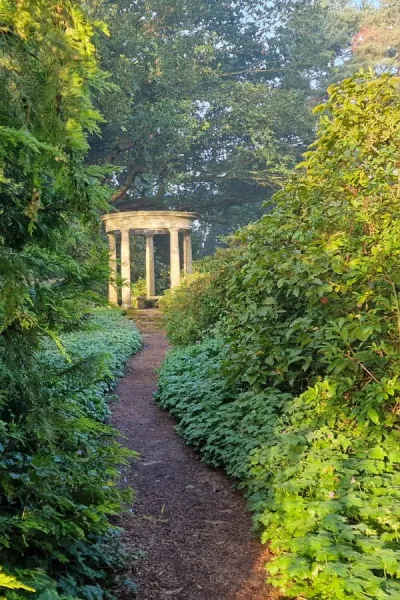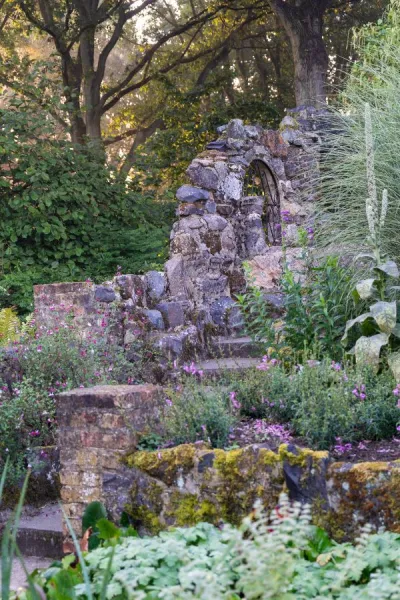
Garden ruins and follies add more to your garden than you think!
If you look up garden ruins or follies in the dictionary, you will be told that they are ‘costly ornamental buildings with no practical purpose.’
However, the dictionary clearly wasn’t written by gardeners. Garden ruins and follies have several practical uses in your garden.
They create a romantic or historic aesthetic, fitting into today’s interest in ‘castlecore’ gardens or Medieval style.
They can be a focal point. They may be used to divide up the space in a garden.
And, according to William Dyson, curator of Great Comp Garden in Kent, they can create a ‘micro-climate’ for growing different plants.
Ruins and follies also add height to your garden, he says. You can grow climbers up them or use them to display plants.
And they can help protect tender plants from the prevailing wind.
You could even turn your garden shed into a folly, as Roger Lloyd did in an evergreen garden with a touch of grandeur.
And on top of all that, garden ruins and follies add drama and fantasy to your outdoor space.
Garden ruins and follies don’t have to be expensive
Follies are part of the design language of the great historic French and English gardens, with their Classical or Gothic temples, pavilions and ‘ruins’.
But they don’t have to be expensive. You can create your own crumbling stone garden structures! Even small gardens could fit one or more stone arches or turrets.
Great Comp Garden is famous for its follies and garden ruins. They make the garden feel magical and mysterious, but they were created in the last half of 20th century by Eric Cameron.
When he dug out the borders at Great Comp, he had to remove a huge amount of Kentish ragstone and flint. So he created the ‘ruins’ to use up the materials. He also kept a sharp eye out for salvaged materials and ‘job lots’ he picked up as bargains. He even did most of the work himself.
So I asked William Dyson about what garden ruins and follies could do for our own gardens.
Use architectural salvage and buy seconds
Great Comp is a lesson on using what you’ve got and re-using anything you can buy cheaply. Eric Cameron was proud of being Scottish and thrifty, and he did much of the work himself.
The Italian Garden at Great Comp is effectively a small walled garden within the main garden. So it is more sheltered and the walls retain the sun’s heat.
Eric Cameron was offered a’ job lot’ of bricks by a builder. He also went to Chilstone, which makes reconstituted stone garden ornaments and architectural stone. ‘There were ‘seconds’ lying around in the yard,’ says William. And because they’d been left outside, they’d already started to look nicely aged.
They also continued to use the flint stones they’d dug up from the borders.
Also look in architectural salvage yards and on exchange sites, such as Facebook Marketplace or Freegle.
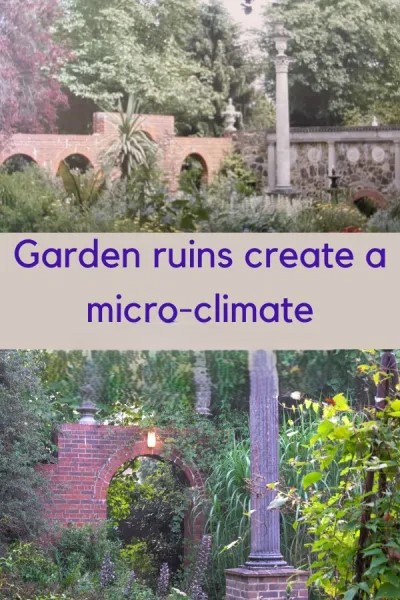
How garden ruins and follies affect plants
William explained that a garden ruin or folly can create a micro-climate so that you can grow specific plants.
At its simplest this means that a wall (it will probably be a crumbling or broken wall!) has two sides. If you position it from East to West, you create a south-facing side and a north-facing one.
The south facing side will get the sun, which will heat the brick or stone. The brick or stone then gives off that heat at night. So you’ll create an area that is just a little warmer and more sheltered than the more open areas of your garden.
On the other side of the wall, it will be shady and cool. That will be perfect for ferns or epimediums, says William.
And you position your wall to shield the plants from the prevailing wind, too.
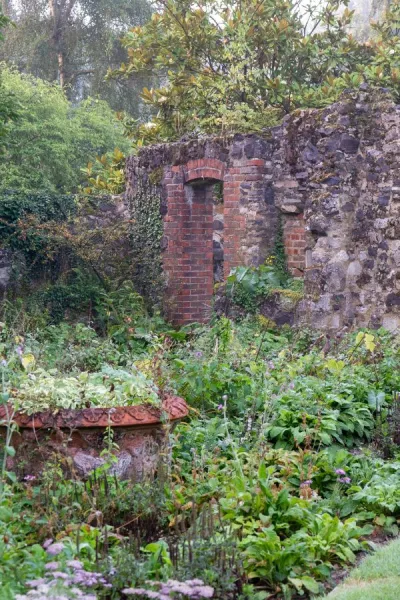
Divide up space or add height
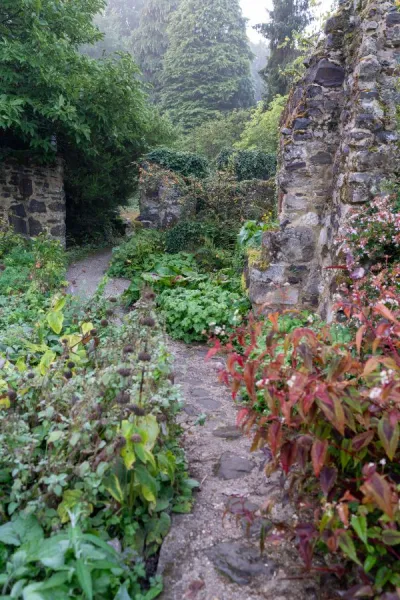
Great Comp Garden was originally fairly open and flat. Now a myriad of paths entice you into the planting, with walls and doorways leading you on a magical journey. At every turn you come across a ruined cottage…or is it a ruined castle?
Occasionally, you look down, to see what appears to be fragments of an old floor.
Garden ruins as a focal point
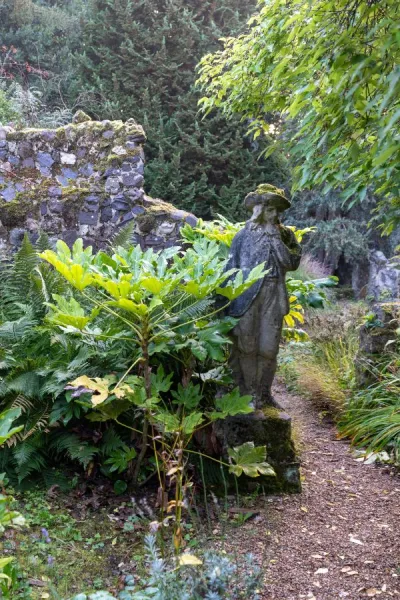
You could choose a spire, a tower or a temple. Or you can add a statue or an urn to a wall or archway.
Bill and Lynda Rudgard saw a Gothic window in a salvage yard and bought it immediately. It was one of a set of windows from a demolished church in Halifax. They shipped it down to their home in Kent, and had it set in flint and stone. They’ve sited it at the end of their garden overlooking farmland, adding some upright stones and pavers in the ground to give the impression that this is all that remains of an old church.

Use garden ruins as seating or raised beds
You may already have some ‘ruins’
If you’ve had a major renovation in your home, you’ll know how fascinating fragments of old paint and paper are.
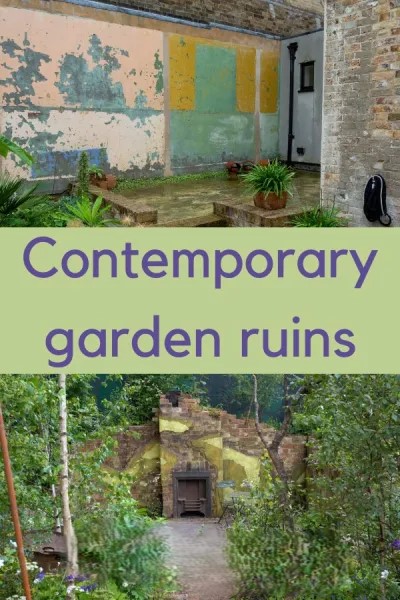
There was a collapsing conservatory in Mark Walker’s Victorian house. It wasn’t practical to restore it or to replace it with another room. So Mark has turned it into a terrace in the garden, letting the marks of the previous layers to be exposed to the elements.
And one of the most magical gardens at RHS Chelsea 2023 was Cleve West’s garden around the walls of a ruined house. It had quite a similar feel to Mark’s back garden.
Where to position garden ruins and follies
William says that when you’re thinking about creating garden ruins or follies, you should ‘consult the genius of the place’.
That means thinking about the architecture and surroundings. Do you want to be in harmony with a particular architectural style? Or do you want a contrast?
Is your folly going to be purely ornamental? Or do you want to use it to display or grow plants on? If so, think about where the sun falls and how the prevailing wind blows.
And think about what it will look like from every angle, including what neighbours or passers-by may see. Also think about what you will see when you’re sitting in or on your garden ruins, if they’ve got a seat.