A small wildlife garden for towns and cities – and it’s really easy to maintain
This small wildlife garden is very pretty and easy to look after. Plus it attracts a wide range of wildlife.
A few years ago, the Rewilding Britain garden won Best in Show at the RHS Chelsea Flower Show. It triggered a vigorous debate in the gardening world.
Is a small wildlife garden realistic, especially in a town? Would it be easy to maintain? And how managed does a garden have to be?
Anne Vincent’s garden was completed before the Rewilding Britain RHS Chelsea show garden hit our headlines. And it demonstrates that it is practical to have an almost wild garden in towns and cities. Anne finds it very easy to look after: ‘I really don’t do much gardening.’
And now, five years after it was completed, it still looks good!
Anne says that it is very easy to look after. And she also never buys plants, because she allows plants to colonise the garden rather than deliberately planting them.
It is a very different approach to gardening!
Key garden details:
The garden is around 60ft (18m) by 17ft (5m). It is in a street of terraced Victorian houses.
You can visit it on Faversham Open Gardens & Garden Market Day. This is held on the last Sunday in June every year (29th June 2025, 10am-5pm) for The National Garden Scheme.
How do you plan a wildlife garden?
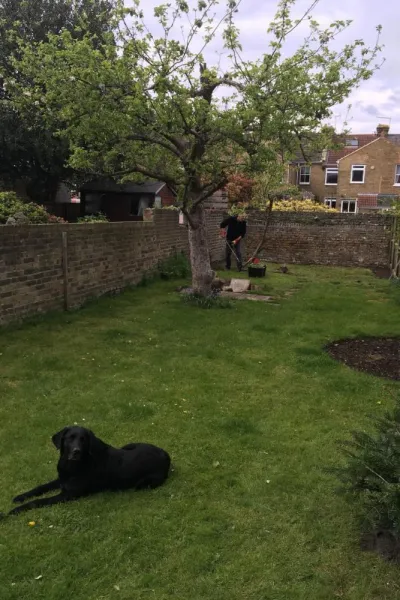
When Anne moved into the garden it was a blank canvas – just an oblong of lawn and a single old apple tree.
Anne’s son, Tom Joyce, was doing an environmental science degree. So he suggested that she turn the whole area into a small wildlife garden.
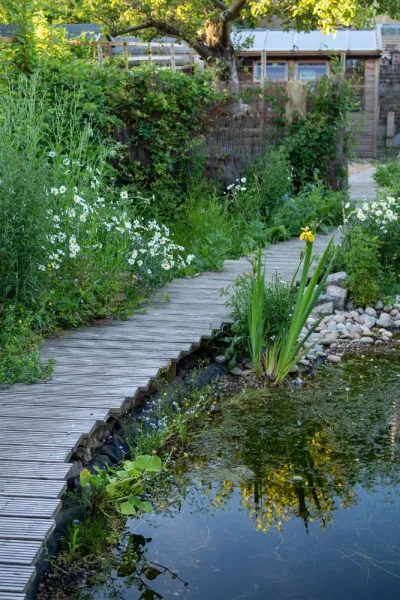
He started with the pond. ‘When my son told me I needed a pond,’ she says, ‘I expected him to dig me a small one at the bottom of the garden.’
However, Tom advised her that a larger pond would look after itself better and be easier to maintain. It would also host more species, such as small mammals and frogs, as well as birds, butterflies and pollinators.
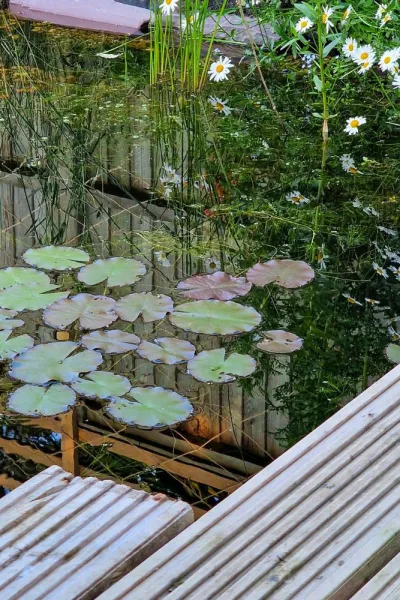
He dug a pond that occupies approximately the first third of the garden. It’s about 20ft/6m by 8ft/2.5m. It’s around 2ft/60cm at its deepest point.
How deep should a wildlife pond be?
There’s no exact rule on how deep your pond should be. All water will benefit wildlife. But if you want a pond which will support a wide range of species, won’t dry out and won’t get too hot in summer, then it should be more than 8″/20cm deep. The RHS recommends varying the depth of the pond, ranging from around 8″/20cm to 2ft/60cm.
All ponds need to have access in and out. In a larger pond, this means you should create a ‘beach’ at one end, with different levels for different plants and wildlife.
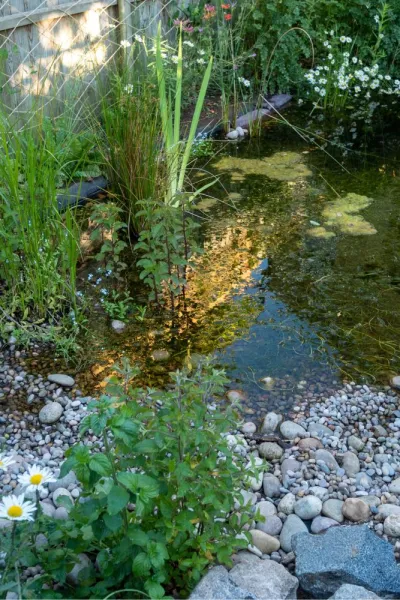
Tom fitted a rubber liner to the pond and added stones. Anne bought pond plants to stock it, concentrating on those which are native to the UK.
If you’re making a small pond out of a high sided container, then you’ll need bricks or stones inside, so that there is some shallow area.
When I interviewed Helen Bostock of the RHS on gardening for biodiversity, she said that adding a pond is the best thing you can do for wildlife in a garden.
Fill the pond with rainwater if you can
If you fill your pond with rainwater, you’re less likely to get the algae and blooms that can cause problems in ponds, explains Anne.
Anne and her son had the guttering re-directed so that rainwater fills the pond rather being washed away into the town drains. This is environmentally helpful as town drainage often can’t cope with sudden flash flooding.
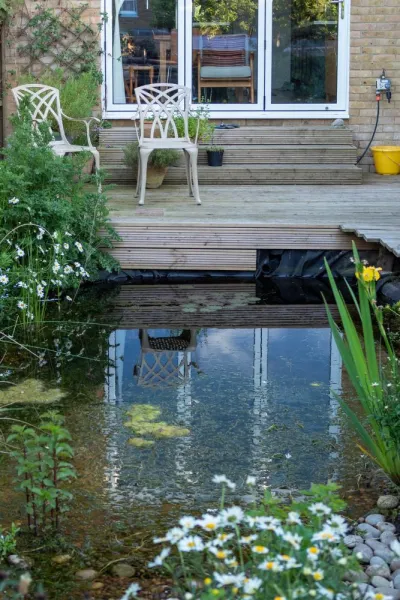
The reaches the pond via the downpipe, which has been extended beneath the deck to end up in the pond. It overflows into an area on the other side of the decking walkway which has been planted up as a ‘bog garden.’ If there is heavy rain, excess water slowly soaks into the soil.
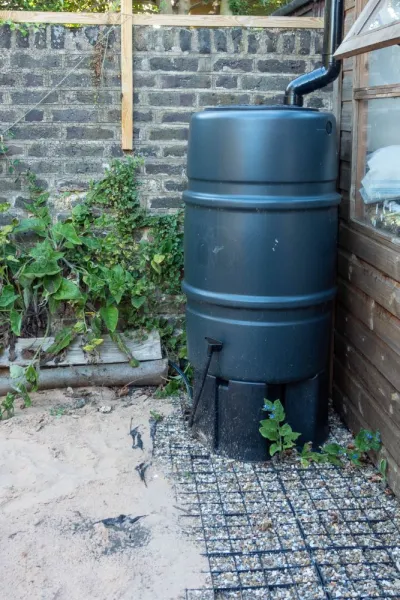
In times of low rainfall, the bog garden can also be topped up from a water butt. ‘I don’t want to use tap water if I can help it,’ says Anne. ‘The chemicals in it would change the acidity of the bog garden.
Water butts often dry up in a prolonged drought, so have the largest ones you can fit in. Anne never waters her plants, so the water butt is only used for topping up the bog garden.
Think about the soil for a sustainable urban garden
Soil is a hugely important part of our eco-system, hosting a wide variety of worms, micro-organisms and funghi that are essential in the food chain.
The issue of how hard surfaces, such as concrete, stone, bricks or artificial grass, damage your soil health is a complicated one. There are many factors to consider when choosing what materials to use for paths and terraces in a small wildlife garden.
These include how porous a surface is (can rainwater drain away into the soil through it), whether worms and other creatures can emerge to breathe and also what happens to the material when it breaks down.
Concrete, for example, leaches lime into the soil when it breaks down. Brick, especially old brick, is a useful ingredient in soil when it breaks down. Artificial turf doesn’t break down – it just wears out and has to go to landfill.
However, Anne has simplified her approach by using a raised deck outside the house and a raised deck path. ‘It means people don’t tread directly on the soil at all,’ she says. ‘And it creates a habitat under the decking. We’ve added stones that we found in the garden.’
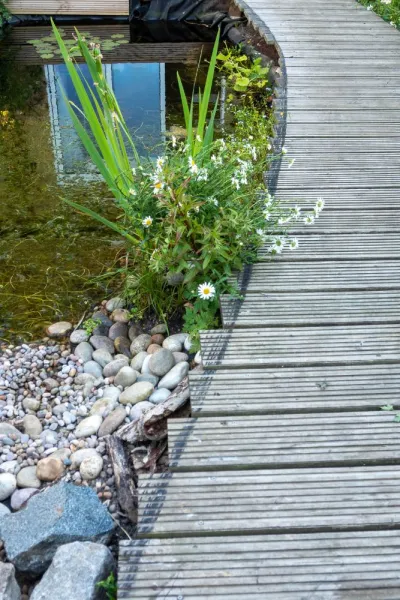
Generally, it’s now considered that digging is harmful to the soil and releases weed seeds.
Wildlife friendly plants for small spaces
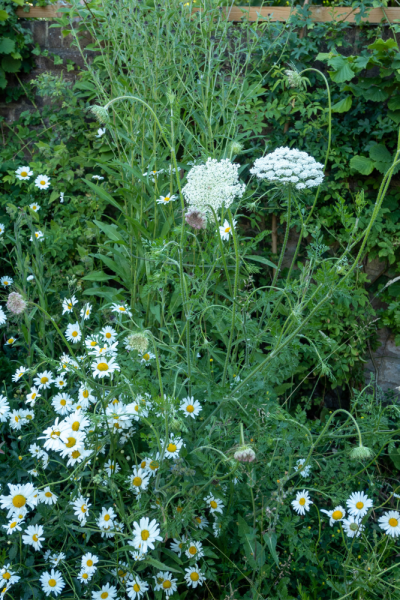
Anne bought plants for the pond, but she hasn’t bought plants for the ‘border’ element of the garden. She did plant some wildflower seeds around eighteen months ago, but otherwise the plants in this garden have simply blown in on the wind or they’ve grown from seeds dropped by birds.
‘I have taken out a few plants that were becoming dominant,’ she says. But she has minimised even doing that. ‘For example, there was a lot of creeping buttercup at one point. I thought it might get invasive, but there seems to be a natural cycle. Other wildflowers arrived. They seem to keep the creeping buttercup under control.
When I visited, I saw oxeye daisies, wild carrot and pennyroyal in flower, along with some lovely purple thistle-type plants.
Use native plants for urban wildlife
Wildlife have evolved to depend on the plants in their own locality. And plants grow best where they are perfectly suited to the conditions.
And sometimes plants introduced from elsewhere take over the wild spaces, out-competing native plants which means that the native species of wildlife that depend on them may also fail.
So there is a strong case for using native plants, even in a small wildlife garden. Although where land is generally managed, such as in towns and cities, there’s much less chance of invasive plants escaping to the countryside.
Once again, this is a complex issue. Seeds and plants have been arriving in the UK via birds, the wind and trade routes for thousands of years. Wildlife has adapted well to much of it, and research by the RHS showed that pollinators benefited equally from both native and non-native flowers.
Some countries, such as Australia and North America, however, have had huge problems with the sudden introduction of a large number of non-native plant species.
As far as the UK is concerned, ‘native’ is generally defined as anything that was here before the last Ice Age. Plants that have been here for centuries are called ‘naturalised.’
You won’t necessarily find out if a plant is native from the label. But you can look it up on the RHS website. And there’s an extensive list of wildflowers native to the UK on the the Wildlife Trusts website.
And wherever you live, you can put ‘is (insert plant name) native to….’ into a search engine and find out.
Hedges and climbers are better than fences and walls in a small wildlife garden
Hedges and climbers offer food and shelter to wildlife. Walls and fences don’t.
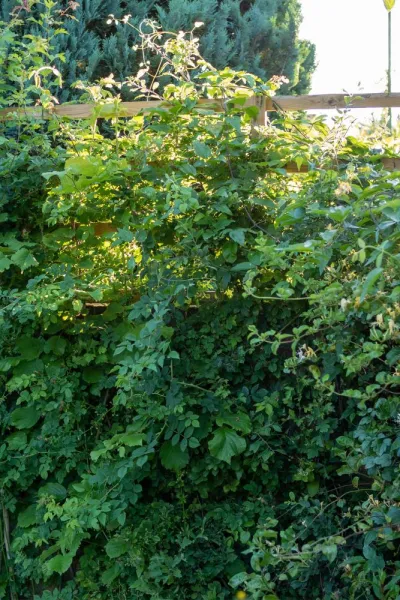
If you have a wall or a fence, you can make them more wildlife friendly by planting a hedge or climbers. Anne has done both. She planted native hedging, such as dog rose, hawthorn, blackthorn and wild cherry.
Create urban habitat garden ‘zones’
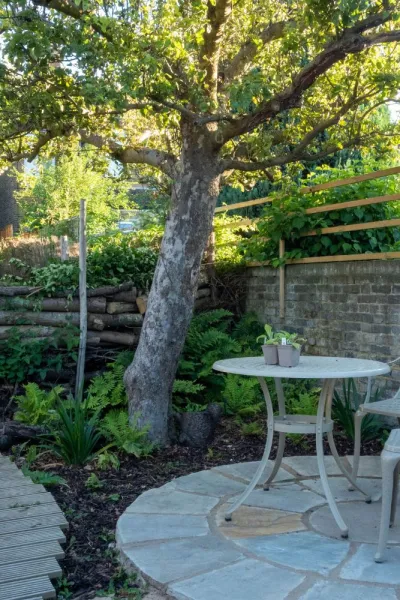
Although Anne’s garden is quite small, there are various different habitat zones and she’s planning to add more. As well as the habitat under the decking, she has created a ‘hibernaculum’. This is a small covered area that can be accessed from the pond, where pond creatures can overwinter and shelter.
She’s added bark chips under the tree, and planted native ferns.
There’s also an area of sand, where she’s planning a sand garden. ‘That’s an idea my son got from RHS Hampton Court one year,’ she says. ‘We’re going to create a sand dune, and see what likes growing there.’
You don’t have to build a bug hotel to create a wildlife habitat. Shrubs, trees and fallen leaves all create shelter for different species. And evergreen trees and shrubs will offer a year round habitat.
If you decide to build a bug hotel, do some research into what is appropriate for insects in your area. There are lots of decorative bug hotels around, but not all are genuinely wildlife friendly. Don’t use wood treated with chemicals or synthetic materials. A pile of garden sticks or dried leaves and grasses is just as good as an elaborate ‘house’.
If you do just one thing to create a wildlife friendly garden…
Don’t use pesticides. They’re the biggest single problem for wildlife.
When they stopped using pesticides at the RHS vegetable garden in Wisley, Surrey, they expected the first year to be difficult.
Once you’ve stopped using pesticides, the pests will flourish. And then the birds and predator insects will move in to eat them.
You’ll never have a perfect garden, but I think we’re all aware that even if you use pesticides, you get the pests coming back.
Learn to tolerate some nibbled plants.
In the end, the team at RHS Wisley was pleasantly surprised to find how quickly the pest-predator cycle returned. The first pesticide-free year in the veg garden was more productive than they’d hoped.
Can my garden be wildlife friendly with artificial grass?
No, artificial grass is not wildlife friendly. You may be told that artificial grass saves water, but it needs washing all year round. It can also need washing with chemicals to prevent the build-up of stains or smells from pet or wild animal faeces.
Artificial grass also prevents the development of a healthy eco-system in your soil. It may not drain properly in heavy rain and can be hot enough in summer to cause burns.
Companies claiming that artificial grass is ‘wildlife-friendly’ say that it doesn’t require watering in the summer and doesn’t need chemical fertilizers or petrol mowing.
However, you can have a much more wildlife friendly garden – with a beautiful lawn and flower-filled borders – without watering or fertilizers.
And Anne Vincent doesn’t water or use petrol mowers. Nor does she use chemicals. Yet she finds her garden very easy to look after.
Shockingly, when I researched ‘wildlife friendly gardens’ on the internet, the top post was published by sellers of artificial grass! That’s what algorithms can do! If you want gardens to be truly wildlife friendly, then please share this or other posts that are based on advice from qualified wildlife and environmental experts. If people read or share responsibly researched posts that genuinely aim to give the best wildlife gardening advice, then the algorithm will notice.
