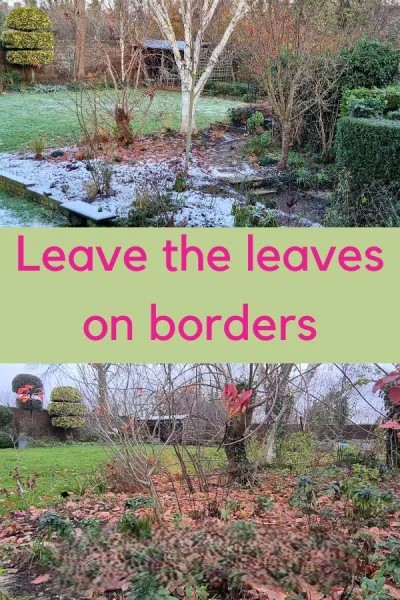
Leave the leaves – the new, easy way to deal with autumn gardens
Leave the leaves is the new gardening mantra.
It appeals to me more than getting out a leaf blower or a rake,then bagging up leaves and finding somewhere to store them. They will break down into valuable leaf mould but they take their time – sometimes it is several years before you will get the benefit. So you’ll be looking at those bags for a long time.
And taking leaves to the local recycling centre in a car is just a waste of time and resources.
Raking leaves was the most boring task of my childhood. My mother ushered us all out for hours of back-breaking tedium.
Should you rake or leave the leaves?
Today’s ‘leave the leaves’ campaign on social media suggests that much of this work was unnecessary.
Others suggest, however, that leaving the leaves could damage your garden or even your health.
Having left leaves on my own borders for 15+ years with no ill-effects, I’ve done some more research to see where we can leave the leaves and where they would be better swept up.
Can you leave the leaves on borders and garden beds?
You can leave leaves on most borders and garden beds without any problem. They will break down over the winter and by spring, you’ll hardly notice them.
As they break down, they’ll return nutrition to the soil.
Piles of leaves also offer habitats to hibernating insects and other wildlife. People have pointed out – correctly – that this includes slugs and snails. But it also includes slug and snail predators, such as hedgehogs, frogs, toads, slow-worms and ground beetles.
There are only two potential problems with leaving leaves on borders.
Firstly, some trees have very thick, big leaves that take a long time to break down. The leaves from my Magnolia grandiflora can cover smaller plants, such as Saxifrage ‘London Pride’. This would deprive them of light, so I do push them off (when I notice).
Secondly, if you leave leaves on paths or walkways, then they may become very slippy. So you can’t leave all the leaves.
Should I cover my flowerbeds with leaves for the winter?
Some people also ask if they should add leaves to their borders. If I’m sweeping up a few leaves from the path, I often dump them at the back of a border.
And an increasing number of people are using garden leaves as mulch. They chop them up with a lawnmower, then spread them over borders.
Or they may do what I do and add piles of of whole leaves.
Either way, the leaves will break down more quickly if they’re left on the soil in a border, because the rain, sun and organisms in the soil will have more access to them.
And a layer of leaves protects the roots of plants. It’s like a warm winter blanket for your borders.
And it’s os much quicker than putting them into plastic bags and waiting for them to break down.
What happens if you leave a pile of leaves?
A pile of leaves on a border offers shelter to beneficial insects over winter. And it will break down to restore nutrition to the soil. So that’s free fertilizer for you!
Even better, a pile of leaves on bare soil takes light away from weed seeds. They’re less likely to germinate, so leaving the leaves helps stop weeds!
Are you wondering how long you can leave the leaves?
Forever! By spring, they will mainly have broken down and become part of your soil. The few scraps of leaves left will quickly be covered up by emerging perennials and bulbs.
So leaving the leaves really does save you work, both in the long-term and the short-term.
Do leaves blow around the garden if you leave them?
Many people see leaves blowing around a city street. They assume that leaves on borders will blow around the garden in the same way. But, mostly, they don’t.
I have tested this in my own garden over many winters. (When I find leaves on the lawn, I can tell where they’ve come from according to what type they are!)
Leaves don’t blow off garden beds if the leaves are at the back, right next to a wall or fence. The wind can’t get behind them to blow them around. I have even left quite a high pile of leaves at the back of a border and it has stayed there, gradually breaking down.
However, if your border is in the middle of the garden, it’s much easier for leaves to blow around the rest of the garden. If you have a wet autumn, they’ll mostly stay where they fall, but in dry, sunny weather you will get some leaves blowing around the lawn, paths or terraces. Not all the leaves will blow around, but some will.
Can leaves be used as mulch?
Yes, leaves make an excellent mulch for garden beds and borders.
There are two schools of thought. There are those who leave the leaves in borders or even sweep leaves from the lawn directly into borders.
And there are those who advise chopping the leaves up first.
Either is fine (except for those big thick leaves, which do need chopping up). The chopped-up leaves will decompose more quickly and are less likely to blow around.
In the spring your perennial plants will push up even through a thick layer of leaves. It’s a natural process.
This leaf mulch will help prevent weeds and will offer a habitat for wildlife, such as frogs, toads and lizards. The leaves will be broken down by micro-organisms in the soil, so your soil will be more fertile and have a better structure.
It’s always a good idea to mulch your flower borders before winter. It can be with leaves, well rotted garden manure, garden compost or other bought organic mulches.
Can leaves be added to the garden compost bin?
Yes. I’ve often added leaves to the garden compost bin. They don’t decompose as quickly as many garden clippings or raw fruit and veg, but that doesn’t have to matter.
Unless you’re sieving your garden compost to plant seeds, then having some partially composted element isn’t a problem. You can spread compost on the garden even if it’s not completely broken down.
However, one effective way of adding leaves to the compost is to mow the leaves on the lawn. Then throw the mixed bag of lawn clippings and chopped up leaves into the compost bin. It’s a perfect mix and will break down quickly.
I also speed it up by using a compost accelerator, such as Garotta.
You can also bag up leaves separately to make leaf mould/ leaf mold.
Leaf mold is a wonderfully nutritious mulch for your garden borders, but I have found that leaves seem to decompose much more slowly when they’re all bagged up together.
If you are going to bag up leaves, make sure they’re moist and tear air holes in the bags. They will take at least 1-2 years to break down.
Is it OK to leave leaves on lawns over winter?
This question causes a lot of arguments. Having looked at many of them, I can summarise it.
If you have lots of leaves, which lie in a thick layer on your lawn, then it will take them months to break down. In that time, your lawn will be deprived of sunlight. This will cause bare patches, especially if you have lots of the thicker, more leathery leaves.
So a thick layer of leaves does potentially damage your lawn.
However, if you only have a scattering of leaves over your lawn, then they will break down naturally, adding nutrition to the lawn.
Is it OK to leave leaves on the ground over winter?
This depends on what sort of ground. You shouldn’t leave fallen leaves on the ground anywhere you’re going to walk. Rotting leaves can get slippy, especially in icy weather.
You’ll need to clear away leaves that fall on concrete, brick, stone, other pavers or decking. In borders they can be reabsorbed into the earth. On hard surfaces, they will just rot away. And once again, there is the potential for people to slip on rotting, wet or icy leaves.
But if you walk through a wood or forest, you’ll see that nature leaves the leaves on the ground!
Is mowing the leaves better than raking?
The easiest way to deal with leaves on the lawn is to run a mower over them. Use a higher setting than you would in summer when the grass is growing strongly.
Many people ask if it’s bad for the lawn to mow the leaves rather than raking them. It’s absolutely fine for the lawn.
Some wildlife experts would rather you raked as you may shred leaves that tiny insects are using as habitat. However, if the leaves haven’t been on the lawn long, then they probably don’t have many insects in them.
Leaf blowers are more disruptive to wildlife than raking is. And it also uses more resources.
You can either throw the leaves and lawn clippings into the compost bin, throw it into the borders as a mulch or leave the chopped up leaves where they are on the lawn. They’ll break up more quickly than whole leaves will.
In the United States, where many of the lawn grasses aren’t native, this debate often veers off into the ‘lawns are bad’ argument.
It’s important to remember that there’s a difference between maintaining a non-native lawn in an area that isn’t suitable for lawns and having a mainly native lawn in the UK, where lawns use up relatively few resources and are both sustainable and wildlife-friendly.
Fallen leaves are good for wildlife
Fallen leaves provide a habitat for a wide range of insects, frogs, toads, lizards, birds and other creatures. They shelter in the leaf litter over winter. Many of these benefit your garden by eating pests.
Some butterflies and moths over-winter in leaves as eggs, caterpillars or another stage of their life cycle. Bumblebees, too, need the insulation of fallen leaves in a quiet spot so that they can survive the winter.
Leaf litter is also a food source for a wide range of wildlife.
Most importantly the micro-organisms in the soil feed on the leaves, helping to break them down. This restores nutrition to the soil.
It’s free and it saves you effort!
Will the leaves cause bad moulds when they rot down?
Nature does not rake up leaves. It allows them to rot down, returning their nutrition to the soil.
Leaves rot down on a forest floor all year round. Forests and woods don’t smell bad. And people aren’t usually warned against walking in them because of ‘bad moulds.’
But if you search whether leaves cause bad moulds (molds) online, you will find hundreds of warnings, almost all from the United States, on the dangers.
Certainly moulds, funghi and fallen leaves are a factor in the autumn. These can trigger allergies, similar to those from pollen in summer. A few of these allergies and reactions can be severe.
But I find it odd that people are much more concerned about this in the United States than they are in the UK.
Are our fallen leaves less likely to cause allergies? Or do some countries worry more about leaves than others?
This may also be a volume issue. If you’ve got one or two trees of different kinds in your garden, then you won’t have a huge number of leaves at any one time. But if your property is surrounded by hundreds of the same deciduous trees all losing their leaves at once, then leaves will take longer to break down. The funghi that help break them down may be around longer.
It may also be worth noting that nature doesn’t sweep leaves into a big pile, so perhaps the balance of funghi and moulds may be different if leaves are in piles rather than simply left.
And not all ‘moulds’ are bad…
You’re certainly more likely to see funghi in autumn, when leaves are falling, but this doesn’t mean that leaving leaves causes them all. Or that they’re necessarily bad.
The Royal Horticultural Society says that most types of funghi are very good for gardens, helping plants to take up nutrients and dead matter to decompose.
Their latest Wildlife garden at RHS Wisley has areas where funghi have deliberately been planted.
There are a few damaging funghi, such as honey fungus and verticilium wilt. But sweeping up your leaves isn’t likely to make a lot of difference to them, one way or the other.
But, as with everything, I think it’s worth taking an individual approach to this. Is there any scientific research done in your area? Have you – or your family – personally experienced problems with leaves in the autumn?
What’s right for one person isn’t necessarily right for another, and if you do get health issues in autumn, it’s important to address them.

Are fallen leaves poisonous to dogs (or other pets)?
As I said in How to Puppy-Proof Your Garden, about 25% of any garden is likely to be toxic to both humans and pets. But most humans and pets don’t eat the plants.
Plant poisoning is relatively rare, but it is vital to keep a close eye on puppies, kittens and toddlers in a garden as a general safety measure. You never know what they’re going to put in their mouths or what other harm they could do to themselves.
The PDSA in the US (People’s Dispensary For Sick Animals) says that dead leaves are less likely to cause problems that green leaves.
There are a few plants which are very toxic, such as oleander or ricinus. I personally don’t grow either for that reason. But you will see oleander all over Europe, with lots of cats and dogs sunning themselves in front of the bushes.
I’d suggest asking your local vet if there are plants in your area that seem to cause problems with dogs or cats eating the leaves.
If you get a vague, general answer, that probably means the vet can’t remember specific cases (so there probably are few or none). If your vet has dealt with poisonings due to pets eating fallen leaves or specific plants, they’ll say so pretty clearly.
Can you leave leaves on paths?
Don’t leave the leaves on paths or places where you walk. It makes them slippy in rainy or icy weather.
But you don’t need to take the leaves very far. I just scoop mine up with leaf scoopers (I currently use these Straeme leaf grabbers) and deposit them in the nearest border (at the back, by the wall!)
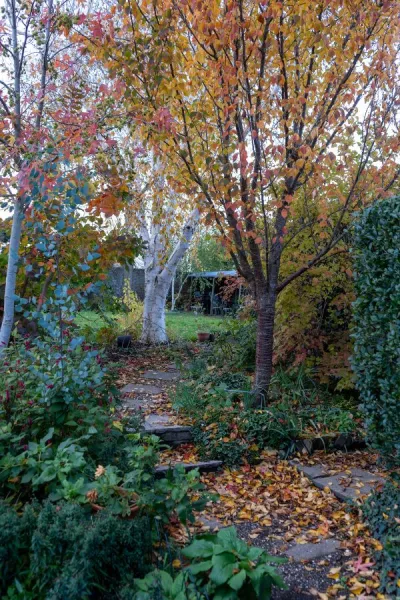
Can leaves grow roots?
Leaves can’t regenerate or grow roots. You won’t find lots of tree seedlings popping up because you leave leaves on your borders or lawn.
