Perennials made simple – how to choose and grow the best plants for your borders
Perennials are the main flowering element of a successful mixed border.
So I went to one of the UK’s premier perennial plant nurseries, Hardy’s Cottage Garden Plants, to talk to Rosy Hardy about how to choose and grow perennials.
What are perennials?
Rosy says that a perennial plant is one that continues to grow in the ground from one year to the next.
A ‘herbaceous perennial’ is a plant that dies back in winter and re-emerges the following spring.
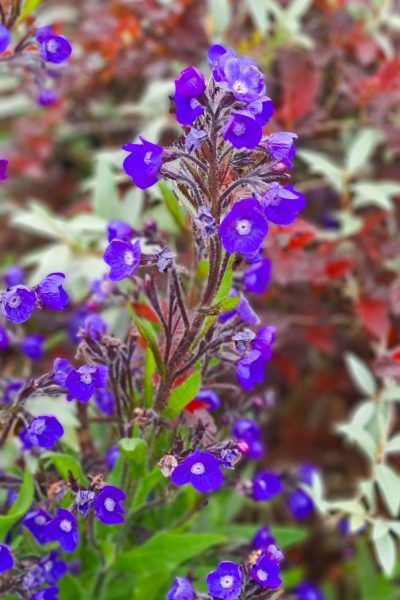
An evergreen perennial has foliage above ground all year round.
Why are perennials important in our gardens?
Perennials are the mainstay of our flowering borders, Rosy says. There are perennials which flower in spring, summer and autumn – even a few flower in winter. You can get perennials of different heights, for shade and for sun.
So you can get a riot of colour for a long season with perennials. And because they come up year after year, they’re less work than plants which need to be planted, dead-headed, fed and then dug up again at the end of the season.
What is a hardy perennial?
‘A perennial grows, flowers, re-grows, flowers – it’s classified as a perennial as long as it lives for at least three years,’ says Rosy. A hardy perennial, therefore, is one that survives our winters.
A ‘half-hardy perennial’ is a perennial in its country of origin. They just can’t survive our winters, so we have to re-plant them every year. ‘In this country, we use a lot of half hardy annuals as bedding plants.’
Annuals are plants that grow, flower, set seed and die in one year. Their seeds come back but the plant does not.
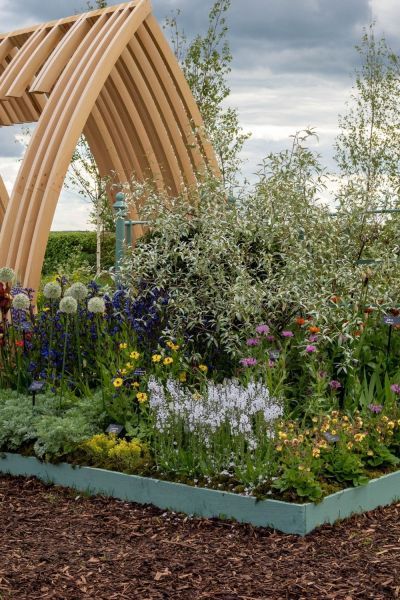
Perennial garden planting has had some exciting new directions over the past decade. One of the most interesting ones is naturalistic planting, which is beautiful and easy care.
If you cover your soil with mulch or landscape fabric, can plants grow back through it?
Some plants don’t like to have their crowns covered,’ explains Rosy. ‘So when you’re adding mushroom compost, garden compost or bark to your borders, leave a ring around where the plant head will grow through.’
Note that when you’re protecting tender plants over winter, such as dahlias, then you will need to cover the crown. I always add several spadefuls of compost. See more about dahlias in a UK winter here.
However, you shouldn’t use weed suppressant landscape fabric on borders with perennials. Rosy explained that weed suppressant fabric is made to cover up weeds and kill them. It’ll do the same for perennials.
Some people suggest cutting a hole in the fabric so that the perennials can grow up through it. But Rosy says that is only appropriate for shrubs, which stay where you planted them and don’t spread. Whereas perennials spread underground through a root system. Landscape fabric will stop that happening. Your perennials will die.
When and how should you divide perennials?
Because perennials spread, they will need dividing every few years. Rosy says that a fast-growing perennial will probably need dividing every 2-3 years. Divide a more slow-growing one every 3-4 years.
‘You’ll know when some perennials need dividing, because the centre begins to die off,’ says Rosy. If you get a bald patch in the middle of your plant, then it’s time to dig it up.
It’s simple to divide a perennial. Dig it up. Then cut away the dead centre and split the plant. ‘Use a spade to cut it,’ advises Rosy.
You’ll see some people recommending that you use two forks back to back to separate the roots without cutting them. Personally I have yet to find anyone who has succeeded in this method. And Rosy says that it’s fine to cut the roots in places – ‘it gives them a root prune.’
Which perennials bloom for the longest time?
Rosy recommends hardy geraniums, nepeta, geums and ‘herbaceous salvias’. Those are the ones that come back year after year, rather than the shrub salvias.
A shrub is a plant with a woody stem that stays above the ground all year round. Shrubs grow larger but they don’t spread.
Which perennials like shade?
‘Anything that’s stated as being a “woodland plant” will do well in shade, advises Rosy.
Hellebores, epimediums, pulmonaria, uvularia and maianthemum are all good for shade. ‘And hardy geraniums are my go-to plant,’ says Rosy.
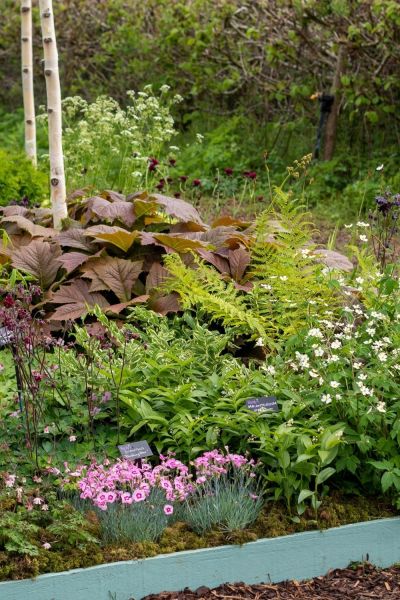
‘A lot of the shade-loving perennials are spring-flowering,’ says Rosy. ‘But most of them have really interesting leaf colour, which will give you good ground cover. ‘ Having good leaf coverage also helps deter weeds, as it deprives annual weed seeds of sunlight.
Which perennials grow best in pots?
Rosy says that all perennials will grow well in pots. But you must place the pot in the right place – sun-loving perennials need to be in pots in the sun and shade-loving ones in the shade.
‘You also need to make sure you get correct drainage, that you water only as much as the plant needs and the right amount of feed.’ If you can get those three right, you can grow any perennial you like in pots.
Which perennials are deer-resistant, rabbit-resistant or slug-resistant?
Rosy says that you can find lists of plants that are considered either deer-resistant, rabbit-resistant or slug-resistant, for example, on the RHS website. ‘However, you’ll always find someone who can tell you that a rabbit, deer or slug has eaten their plant.’
If deer are a problem, build a higher fence, she advises. Rabbits, too, are best deterred with a fence but make sure you use a wire with small holes. ‘Often people use a wire with larger holes that the rabbits can get through.’
As for slugs, she protects her young plants, such as hostas, with small amounts of organic slug pellets. But that’s only to protect the new, young shoots. Once the plant is larger, she says it will survive a few holes.
And Hardy’s Cottage Garden Plants is very wildlife-friendly. ‘We have birds, butterflies, newts, frogs, toads, voles, owls and more. They eat many of the slugs and snails.’
Which perennials are best for wildlife and pollinators?
Any of the flowers are good for pollinators,’ says Rosy. ‘It’s a myth that double-flowered flowers are no good for pollinators. Bees don’t like them because they like a nice flat platform and an open flower, but moths, butterflies, beetles and other pollinators are able to get into even quite elaborate double flowers to get the nectar and pollen.’
Go for as wide a variety of flowers as possible and try to have something flowering in every month of the year. That is the best way to support wildlife and pollinators.
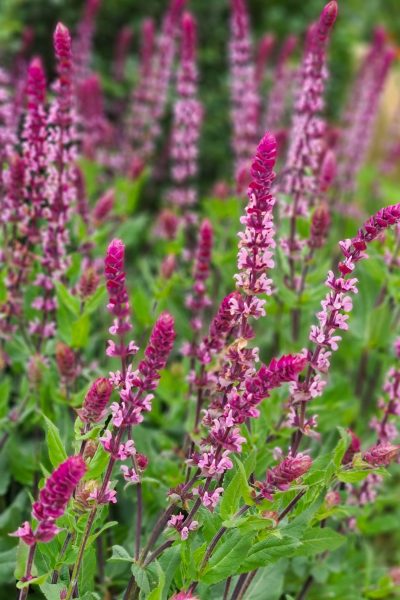
How to partner plants and flowers when planning a border?
Rosy starts with ‘right plant, right place.’ That means making sure she knows which parts of the border are sunny, which are in shade and which in part-shade. She makes sure that she chooses the appropriate plant for the position.
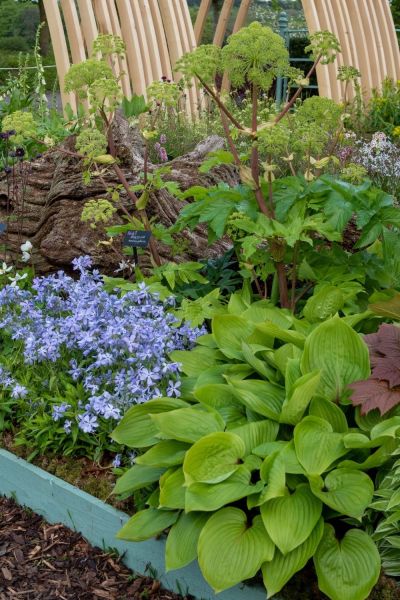
Then she likes to contrast big bold leaves with frothy, airy flowers. ‘Always tie in colour. If you have a bronze leaf, then maybe plant a plant with a bronze stem in front of it.’
She also partners different shapes of leaves. For example, a bronze Rodgersia and Hosta ‘Purple Heart.’
Look at how the colours go together. ‘It can even be as intricate as looking into the centre of a flower, and picking up the colour at the centre, then repeating it in a different plant.’ For example, a verbascum with a red heart could be partner with a red flower.’
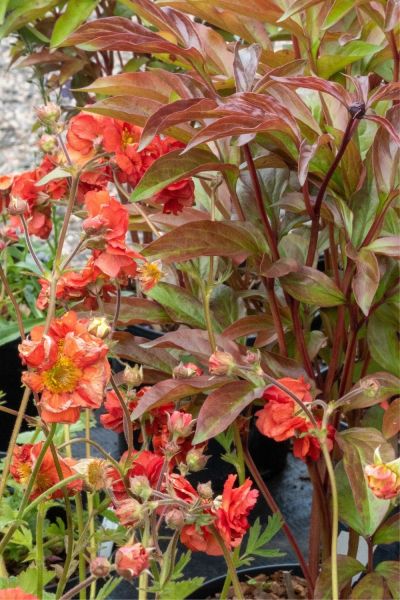
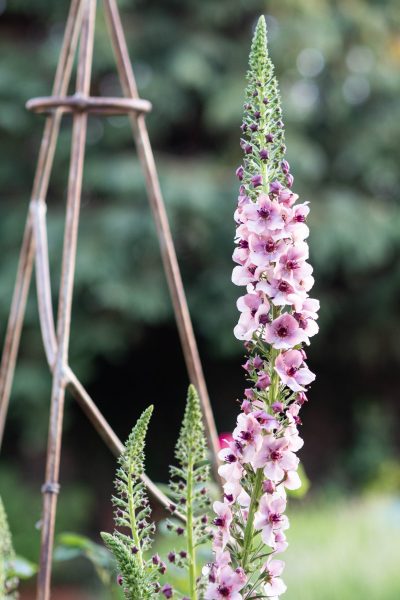
Rosy also repeats plants or groups of plants, sometimes varying them. So the bronze-leafed Rodgersia is repeated along the border, but is partnered with a different shade of hosta.
‘And contrast flat flowers with round ones, add in spikes and big shapes – mix them all together.’