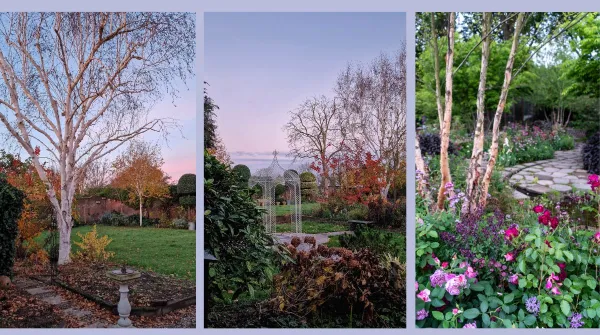
Top tips for trees – what you really need to know before you prune your trees
A tree is often the biggest feature in a garden. Prune your trees well, and it lifts the whole space—bringing in light, structure and beauty.
But prune a tree badly, and you risk creating a dark, messy, unkempt garden with trees that grow back even larger – and thicker – than before. Here’s what tree experts want you to know before booking tree work.
You may not intend to prune your trees yourself.
Even if you hire a tree surgeon, there are key facts worth knowing.
Understanding the basics of tree pruning will help you:
- Find a skilled, qualified tree surgeon
- Get healthier, more beautiful trees in the long run
- Avoid being conned by unqualified tradesmen who may just hack at your trees
Pruning trees isn’t as simple as cutting them down to size.
Some trees can be reduced in height but not in width. Others respond badly to heavy pruning or branches being shortened. They will be stimulated to put on even more growth afterwards—leaving you with bigger, more dense and less attractive trees.
When should you prune your trees?
- Autumn and winter are a good time to prune most trees, says Wayne, because they’re not growing.
- Some trees, such as the prunus (cherry) family should be pruned in summer.
- You can look up the ideal time to prune a particular kind of tree online.
But if there’s a branch growing where it shouldn’t or you don’t have any other time to prune, then you may not always be able to prune at the best time. The time of year probably won’t matter if you’re just removing the odd branch, but for a major prune, the best timing is important.
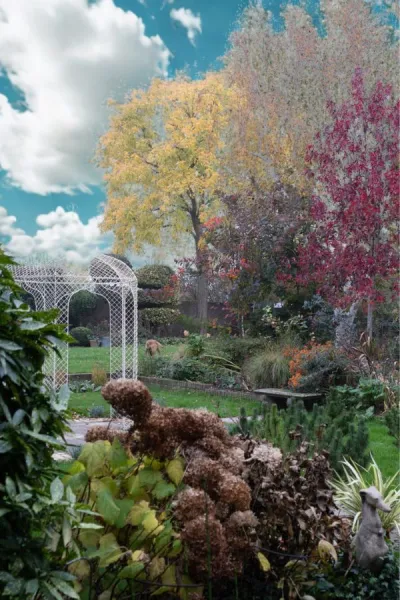
How do you reduce the height of a tall tree?
Wayne explained that different types of tree need to be pruned differently. So it depends on the tree.
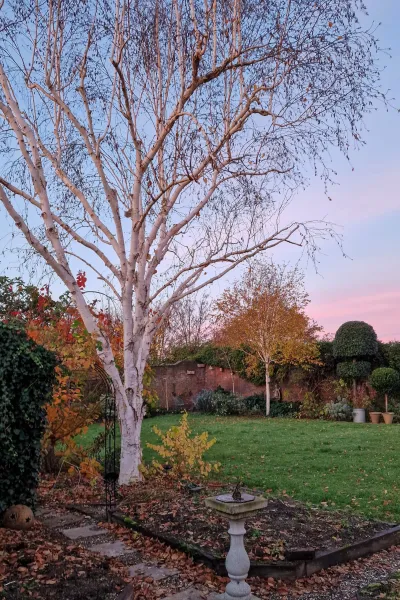
- Birches: They dislike heavy pruning, says Wayne. Cutting into the heart wood can cause lasting damage. A birch should only be pruned gently, thinning out selected branches.
- Many Other trees: Simply cutting across the top often stimulates vigorous new shoots, leaving you with a denser canopy, more shade, and a spoiled shape.
- Exceptions: Some species, such as Lawson cypress, can be reduced by cutting off the top growth. Topiarised trees can also be strimmed across the top.
Always think long-term. A tree may look smaller immediately after pruning, but unless it’s done correctly, you’ll just encourage stronger regrowth.
‘A client might be pleased to see that we’ve pruned a tree back so that it looks really small,’ says Wayne. ‘but long term, you’re going to promote more growth, a thicker canopy, more leaves and larger leaves.’
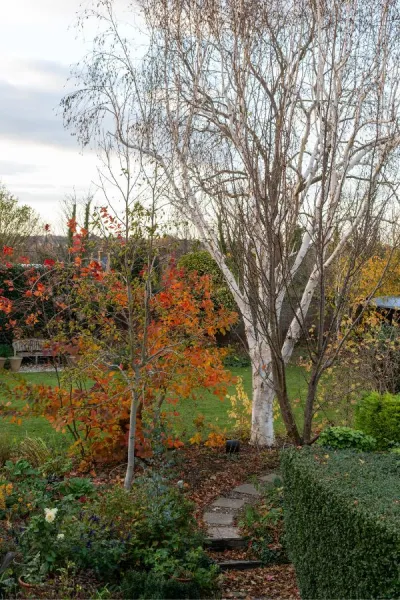
How do you prune a conifer?
You can reduce a conifer’s height, but reducing its width is much harder.
- Trim conifers regularly if you want to keep them neat.
- If you leave them, branches will grow to their full length. Some of this length will be bare of leaves. You won’t be able to cut back into it unless you want to expose bare ugly stems as the leaves won’t re-grow from ‘old’ wood.
- If you want more light or planting space at ground level, “lift the crown” of the conifer. This means removing the lower branches to allow in more light underneath.
‘Lifting the crown’
If you’re trying to reduce the impact of a large, mature evergreen, such as a conifer, you can cut off the lower branches. This is known as ‘lifting the crown’ or ‘lifting the skirt’.
When we first moved in, over twenty years ago, a friend suggested we remove the lower branches from our conifer. This created much more light around the base of the tree.
Wayne’s team took more branches off and really lifted the crown. This has made even more difference and will mean I can grow more around the tree.
Other evergreen trees – can you topiarise evergreen magnolia?
We have an overgrown Magnolia grandiflora. It’s about 25 years old and we have never pruned it.
A friend suggested that I topiarise it. In the United States this tree is often topiarised and it looks wonderful.
However, Wayne told me that topiarising has to be started young. It would take a very long time to get a tree to re-grow into a shape.
But if you start trimming and shaping when the tree is only a few years old, then you can topiarise evergreen magnolia. It’s important to trim every year, however, to keep the shape.
We have, however, topiarised a mature holly as well as two holm oaks, which we planted as young ‘whips.’
How do you prune a very young tree?
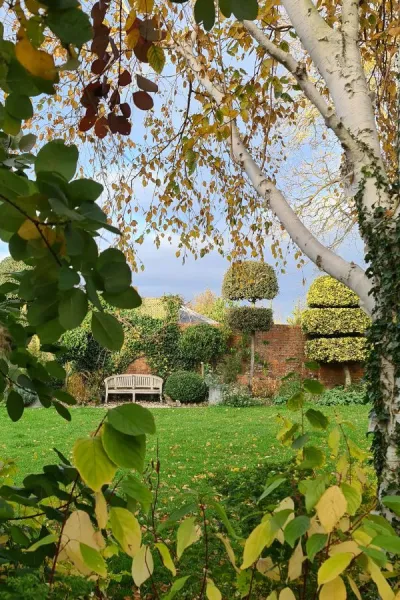
I planted a young silver birch in the far corner of my garden about two years ago.
Wayne advises me to do ‘formative pruning’.
This is how you make sure that young trees grow up into the shape you want.
With young trees, formative pruning is key.
- Look at the shape and remove branches you don’t want.
- Take out crossing or awkward growth.
- Small cuts heal quickly and don’t scar.
‘When a tree’s really young, you can remove branches you don’t want. And you’re only making small wounds,’ he says. These heal better and don’t leave marks.
‘Formative pruning is suitable for any very young tree.’
With any pruning, it’s important to make clean cuts. Use a sharp saw or loppers so you don’t tear the wood.
What about pruning a mature tree?
Older trees are pruned mainly to:
- Create more light
- Lift the crown
- Remove dead wood and check for safety
For example, my 40–50-year-old Robinia ‘Frisia’ only needed dead wood removed and a gentle canopy thin.
Mature trees should not be “topped”. This is when people cut all or most of the top of the tree off. It ruins the shape and can weaken the tree.
And never cut back large branches to stubs or shorten the branches. This will create ugly new growth around the stubs. A large branch should be taken off just an inch or so from the main trunk, where it can heal.
Wayne also spotted an “included union” in my robinia. This is where two main uprights of the trunk had fused. Wayne says that this can make the tree canopy weaker and cause the tree to split. But a careful, minimal pruning can reduce the strain.
How to prune a very upright or ‘vase-shaped’ tree
Trees like my Prunus ‘Snow Goose’ can’t simply be cut down from the top. That stimulates extra shoots and spoils the shape.
It would also make the tree thicker – and therefore your garden could end up darker.
Instead, whole branches can be thinned out, making the canopy lighter and narrower while keeping the tree’s natural elegance.
It keeps the shape of the tree intact.
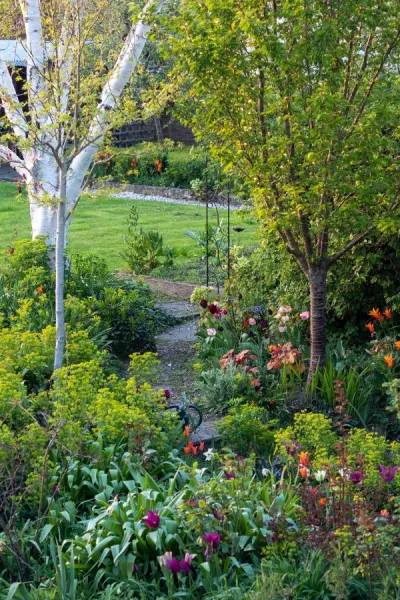
Vase-shaped trees are good for screening over-looking windows or blocking out an ugly light.
How do you prune birch trees?
Wayne explained that birch trees are very sensitive and don’t respond well to heavy pruning. They may start to over-compensate by growing too many new shoots or the wood in the centre may rot.
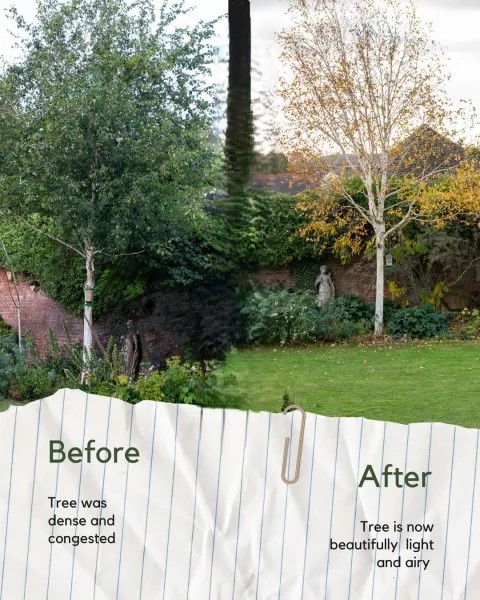
I have one silver birch that is around 15 years old. It was looking very dense and the advantage of birch is that it’s light and airy.
At 15, it’s too late for formative pruning, but Wayne advised a light pruning to make the crown more airy. He also pointed out that there was a climber in the tree, which could be removed.
Are climbers bad for trees?
Arborists don’t like finding climbers growing through trees. ‘If you’re trying to do work to a tree or assess its health, then a climber gets in the way. And it can cover up defects,’ says Wayne.
Many people think that ivy, for example, kills trees, but it doesn’t. ‘Ivy isn’t a parasite, it won’t kill the tree,’ says Wayne. ‘But it can cover up problems in the tree and get in the way of good pruning.’
Ivy is a wonderful habitat for wildlife, especially in winter, so there’s always a balance to consider, says Wayne.
If you live in the United States, check whether English ivy is invasive in your area.
Can you plant 3 (or more) trees very close together to achieve a multi-stemmed effect?
When we re-vamped the garden in 2010, there was a fashion for planting three trees together in the same hole to achieve a multi-stemmed effect.
Two of my trees failed and only one thrived. I’ve known several other people have similar issues, although I do also know one or two people where this has been successful.
Wayne said that tree nurseries now widely supply multi-stemmed trees. It’s better to buy them multi-stemmed because many people do find that one or more trees fail if they’re planted in such close groups.
One of our three trees died immediately. Another simply failed to thrive. So we dug it up and moved it two years ago.
‘The trouble is that when they’re planted so close together, it’s difficult to dig them up without cutting the root ball too much,’ says Wayne. So the tree often won’t do any better in its new spot.
And indeed the tree we moved two years ago has never looked any happier in its new spot.
Wayne suggested we take it out. Young silver birches are not expensive and we’d probably be better off replacing it.
Can you keep a large tree small?
We have a young tree – a Liquidambar – which is around 10 years old. It could grow much taller in the next 10 years, but we want to keep it at around the height it is now.
I asked Wayne how we should go about this. He said that we would have to reduce it in height within the next five years, then continue to prune it back to the same point every five years.
Because we’re starting when the tree is not yet mature, there shouldn’t be too much reduction each time, so it shouldn’t stimulate too vigorous a re-growth.
Ideally, however, choose a tree that won’t grow too tall.
You can also fit a tree into a small space by using a specialist technique such as espaliering.
How to find a good tree surgeon
Word of mouth is a good way to find a tree surgeon. We engaged About Trees because a friend recommended them. These friends have several beautiful mature trees and I really liked the work done on them by About Trees.
A good tree surgeon has two vital skills:
- Practical safety and equipment use
- Knowledge of how trees grow and respond to pruning
That’s why hiring “a man with a chainsaw” is the worst thing you can do. Unqualified work can damage your trees for life. There have also been recent newspaper reports of gangs posing as tree surgeons and conning people out of large sums of money.
You can find qualified tree surgeons and arborists by consulting The Arboricultural Association in the UK and the International Society of Arboriculturalists worldwide.
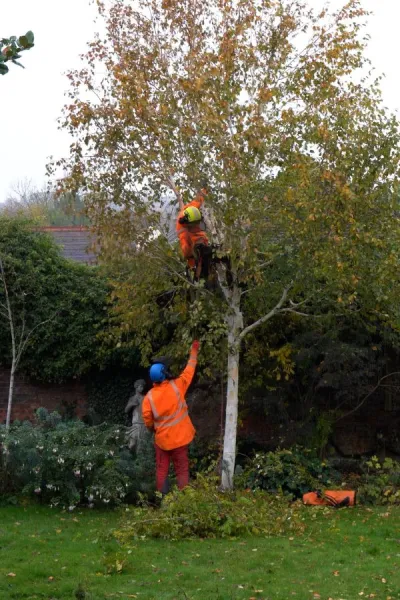
Wayne explained that tree surgery is divided into two skills. One is the use of the equipment and safety. The other is what specific trees need, how a tree works and how pruning differs. That’s why simply getting hold of someone who can use a chainsaw could be the worst thing you do for your trees.
How much does a tree surgeon cost?
I think it’s important to recognise that it costs money to prune your trees properly. It’s probably the biggest investment you’ll make in terms of garden maintenance.
I wouldn’t want to tell you that you can do this yourself ‘easily’. Pruning trees yourself can be very dangerous.
Nor do I think it’s right to suggest that all you need is a few good tips and then you can engage anyone who knocks at the door claiming to be a tree surgeon and offering a discount ‘because they’re in the area.’
Tree surgeons have expensive equipment to maintain and a high level of skills. A cheap tree surgeon won’t know as much about the trees and how they should look. Good tree surgeons are also likely to be booked up. They don’t knock on doors offering cheap services.
If you have a small garden with just one or two trees, think about spending hundreds of pounds (or dollars) on a good tree surgeon.
In a middle-sized garden like mine, then you can expect to think about the low thousands. You probably only have to call a tree surgeon in every 5-7 years, or not even that.
