The Garden Design Details That Make A Town Garden Feel Bigger and More Beautiful
Garden design details make all the difference between an ordinary garden and one with the ‘wow factor’.
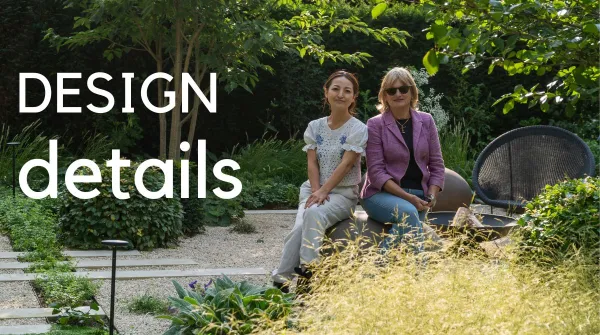
In this town garden, top designers Charlotte Rowe and Tomoko Kawauchi reveal how paths, levels and seating areas can make a space feel bigger, more magical and show off the planting.
It’s a private garden on the edges of London with three distinct garden areas. There’s a front garden, a surprisingly spacious side garden and an upward-sloping back garden. So Charlotte and Tomoko had to make each very different space work in itself, then link the spaces together to create a harmonious ‘journey’.
The secret to making it work is in the garden design details. And the lessons apply to any garden, whether large or small.
Here are the key principles they use, and how you can apply them to your own garden.
Think About Function First
Before choosing plants or materials, decide how the garden needs to work. Do you want areas for dining, play, or quiet retreat?
- Action point: Write a short list of how you and your family want to use the garden. This will help guide every design decision.
- Charlotte and Tomoko always place functionality first, then decide on levels, patios, and terraces to match those needs.
Create a Journey Through the Garden
A well-designed garden encourages you to explore, with paths leading to seating areas or destinations. Tomoko says that you should think of different ways to approach, for example, an arbor or a dining area. Then you can either choose the most interesting routes or connect them together.
If you can’t see the garden all at once, it will feel bigger. So creating a journey is a major element in turning your garden from a small space into an adventure.
- Action point: Think about how people would logically move from A to B. Charlotte thinks that town gardens are naturally ‘rectilinear.’ The limited space means that a straight line is probably both the most practical and visually satisfying. ‘Curves work better in larger, country gardens, where they feel more natural.’
- This sense of journey makes even a medium-sized plot feel bigger and more intriguing.
Work With Levels, Don’t Flatten Them
Changing levels can be expensive and often reduces character.
Tomoko explains that if you have a slope going up behind your house, then it will be very expensive to flatten it and take away the soil. You will also lose light. ‘And it’ll look like a squash court,’ warns Charlotte.
- Action point: Keep existing levels where possible and design paths, ramps, or terraces to flow with them.
- Shallow, wide outdoor steps are safer and more inviting than steep ones — aim for generous treads and consistent heights.
- Charlotte says that builders and architects often don’t realise that garden steps need to be lower than interior steps. Around 130mm-150mm is considered a good height. And it’s essential to have the same height and tread depth through the set of steps. Irregular step measurements are dangerous!
Choose Garden Design Details That Harmonise
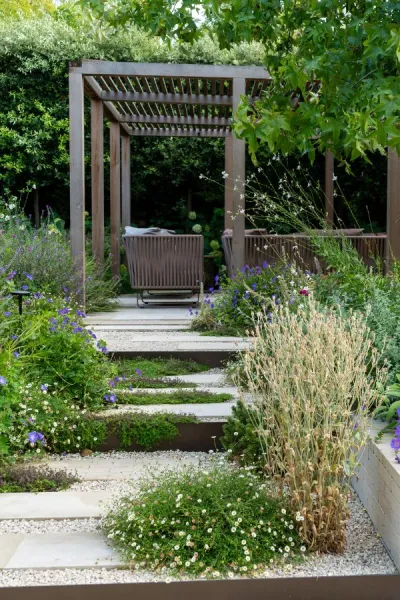
Hard landscaping sets the tone. Natural stone, gravel, and brickwork age gracefully and tie planting together.
Charlotte prefers stone to porcelain as it feels and looks more natural.
- Action point: Decide your main paving material first, then match gravel or other surfaces to it in tone.
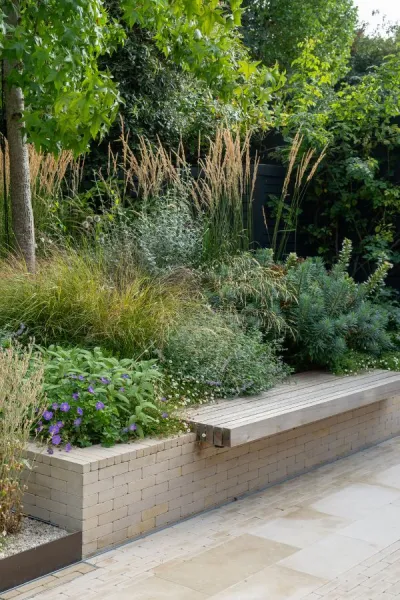
- Repeating materials (for example, bricks used in benches and steps) creates unity and a sense of calm. You can use a mix of pavers and gravel to keep the look soft, and allowing rainwater to drain away more easily.
Use Planting to Soften Structure – And Structure to Display Planting!
While structure is essential, planting brings it to life. And the reverse is also true.
‘When people come into this garden, they immediately say they love the planting,’ says Charlotte. ‘But without the structure, the planting wouldn’t look as good. If you have a limited space, such as a town garden, you can’t create a good garden through planting alone.’
- Action point: Mix heights, textures, and seasonal colours. Use tall grasses, perennials, and shrubs as punctuation points.
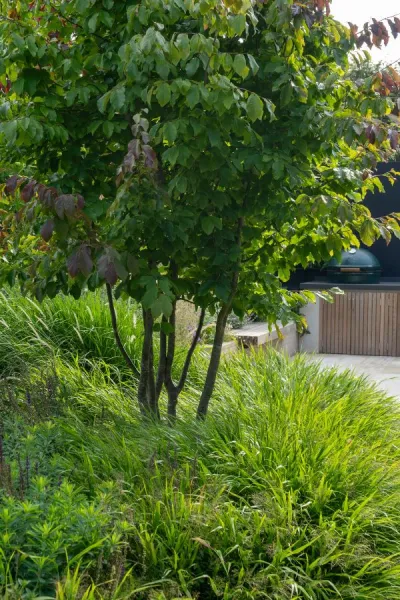
- Keep some existing trees if possible, then add multi-stem feature trees for year-round interest.
Scale Furniture to the Space
When Tomoko and Charlotte design a space, they envisage the size of the furniture that will go in it.
If you are adding a new seating area, terrace or patio, think about what furniture you will need and how big it will be before you lay any pavers or decking!
And don’t hesitate to have big generous furniture in a small space. Charlotte says that buying small pieces or pots for a small garden is a typical amateur mistake.
- Action point: Buy the best your budget can afford, and opt for neutral colours that won’t date.
- Good quality outdoor furniture is an investment — cheap sets rarely last more than a few seasons.
- Charlotte says that trends in outdoor furniture are getting more sophisticated. ‘A few years ago, everyone had the same teak dining table and some nice chairs. But now people are interested in some of the well-designed garden furniture from Spain, Belgium or other parts of Europe.’
Keep Garden Design Details Simple
Strong design comes from restraint. Tomoko says that overly decorative features or too many materials can clutter the space, making it feel smaller.
This garden has two different areas – the back garden and the side garden. They are different shapes. The back garden is sloping and the side garden is quite shady. The furniture in the two seating areas is very different, but it is all contemporary in style, with simple shapes and neutral colours.
And the stone, pavers, stackers and gravel run throughout both garden areas, as well as the front garden. There’s lots of interest but it’s a strong over-arching design.
- Action point: Limit yourself to a small palette of materials and stick to it. This is how garden design details make the space feel less busy and therefore larger.
- In contemporary spaces, rectilinear lines often work best, with planting providing softness and flow.
Front Gardens Need Different Rules
Your front garden should connect visually with your house, says Tomoko. Charlotte adds that it’s important to have good drainage and to follow any local rules on it.
- Action point: Keep front gardens as permeable as possible with gravel or planting beds to help reduce flash flooding risk.
- Match the style of paving and planting to the character of the building, whether traditional or modern.
We genuinely hope that you found our article helpful,Happy Reading!
