
Winter pots – really useful tips!
Did you know that planting winter pots is a little different from planting summer pots?
And that’s not just because the plants need to be winter-hardy.
So I went to our local garden centre, Maytree, with garden designer and Great British Bake Off finalist Jane Beedle to find out more about choosing and planting winter pots.
You need more plants in winter pots
When you buy plants for summer pots, you know they will grow. A few small plants can turn into a wonderfully exuberant display.
But plants don’t grow in winter. So Jane advises you to buy more plants than you would in the summer and pack them in tightly. ‘The way they look now is the way they’ll look at the end of winter,’ she says, adding ‘provided that they survive.’
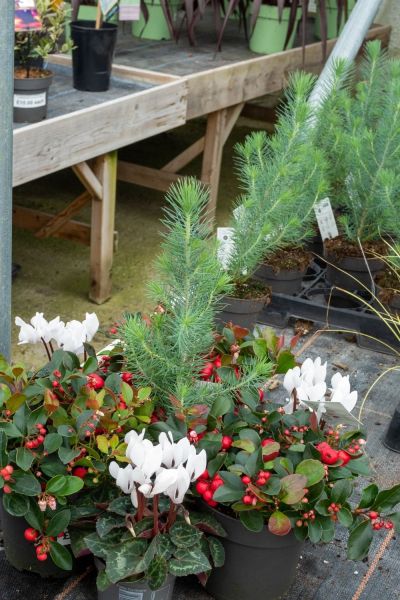
You can also plant a wide range of shrubs and perennials in winter pots. Because they don’t grow, they’re unlikely to outgrow their containers in one winter. And when they do grow, you can plant them out in the garden rather than throwing them away as we do with most bedding plants.
You don’t need to change all the compost in winter pots
Because plants grow in the summer, you need to give them new compost. And you need to feed them.
‘In winter, they won’t be growing, so you don’t need to feed them,’ says Jane. ‘And I just take the top layer of compost off and replace it with new.’
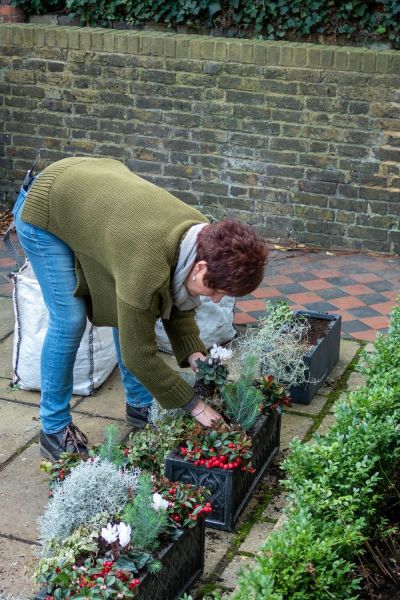
She took off approximately a third of the compost in her pots and window boxes.
But watch out for pests…
‘However, if you spot any pests in the compost, you must get rid of all the compost in the pot,’ she advises. Watch out for vine weevil grubs in particular: ‘They’re little white grubs that look like maggots, curled round. They live on the roots and leaves of plants.’
You’ll also know you’ve got vine weevils if your plant suddenly seems to have no roots!
It’s easier to switch plants round in winter pots
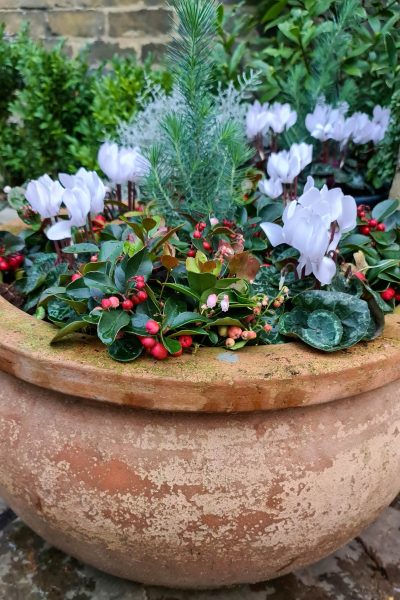
Jane used red cyclamen, silver stone pine (Pineus pinea ‘Silver Crest’) and red-berried Gaultheria (Gaultheria procumbens) for this year’s winter pots and window boxes. ‘The cyclamen will probably flower until late winter or early spring.
After that you can take them out of the window boxes easily, because their roots won’t have grown. Then you can replace them with something like polyanthus, primula or primroses.’
You can save money if you re-use plants in winter pots
Winter pots can cost more than summer pots to plant. That’s because you need to buy more plants. However, you are more likely to be able to re-use plants in winter pots.
Jane re-planted her window boxes from scratch last winter.
Now, a year later, she has re-used all those plants, either in her summer window boxes or in the garden.
‘I hate wasting plants,’ she says. ‘Last winter, I had a silver, green and red theme with eucalyptus, barbed wire plant, ivy and red cyclamen. I gave the eucalyptus to a friend (me) and planted the cyclamen around the garden. The barbed wire plant and the ivy have flourished so Jane has left them in to do their second winter in her pots and window boxes. ‘I don’t think I’ve wasted anything. Which is important because winter pots in particular are expensive. You can spend around £100 on filling a few window boxes and pots. ‘
Evergreen plants in pots are often particularly long lasting.
And one ‘rule’ which is the same for summer and winter pots
Don’t have too many colours in one pot or grouping of pots! Of course, all rules are made to be broken, so if your heart lifts at the sight of a pot full of different colours, then why not? It’s your garden.
But I’ve noticed that when I ask experts about colour schemes for pots, they always say ‘limit your colours to three.’ And don’t forget that green is a colour.
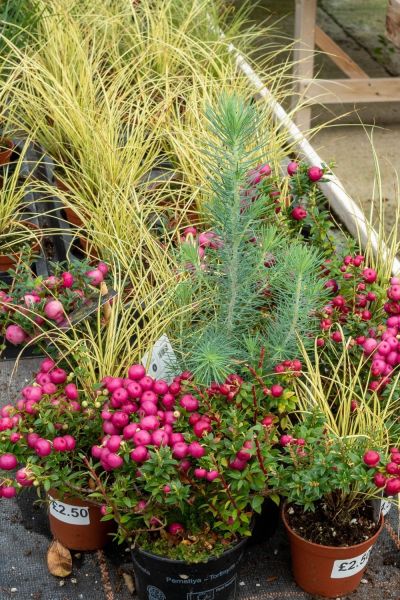
And a rule can be a helpful thing when you’re faced with an array of plants at the garden centre.
Just add lights…
Jane thinks that it’s particularly cheering to add battery-powered fairy lights to winter pots and window boxes. If you buy them with a timer, you don’t even have to remember to switch them off.
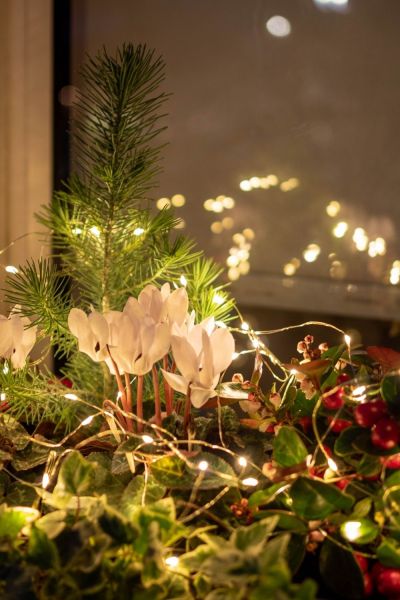
Don’t forget that they need to be suitable for outdoor use. I’ve bought these outdoor fairy lights with a timer. Note that links to Amazon are affiliate so I may get a small fee if you buy, but that won’t affect the price you pay. And I only recommend things I buy or use myself.
