The Low Maintenance Garden That Really Looks Fabulous
The phrase ‘low maintenance garden‘ usually conjures up an image of dull, regimented shrubs and evergreens.
But writer Anne Wareham and photographer Charles Hawes have created Veddw, a garden bursting with personality, colour and structure.
And, as the author of The Deckchair Gardener, Anne is known for her no-nonsense approach to what she regards as unnecessary gardening chores.
At two acres, Veddw is a large garden, but the low maintenance garden tips work in small and middle-sized gardens too.
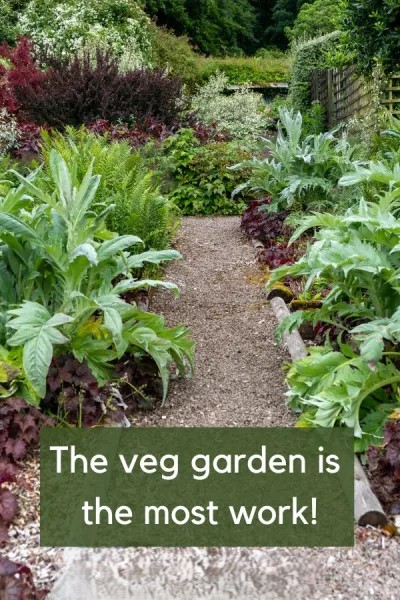
Give Up Growing Veg (Unless You Love It)
Vegetable gardening is the hardest work in gardening because food crops need almost daily attention. They grow fast, so are more likely to need watering and fertiliser. And they’re vulnerable to pests, so need protection.
Growing your own can be hugely rewarding. But it does not fit into a low maintenance garden.
If you don’t love growing food, let it go. Focus on flowers, trees and shrubs. Add a fruit tree if you still want some home-grown produce.
Plant Vigorous Plants (Thugs) to Cut Down on Weeding
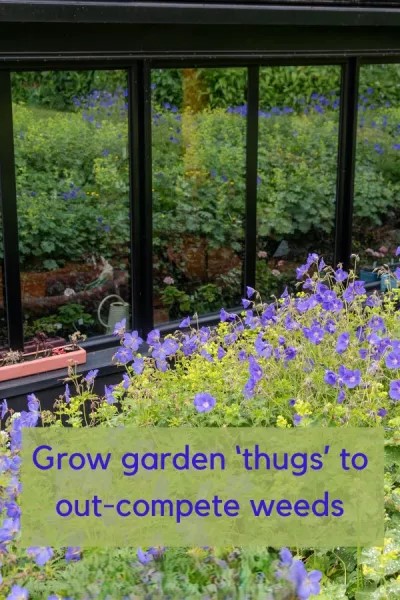
Anne plants big drifts of vigorous plants that spread quickly to fill the borders. She calls these plants ‘thugs.’ She also thinks that this works best in design terms: ‘I don’t like plants in fiddly ones and twos dotted about.’
Strong-growing plants quickly cover the soil and crowd out weeds. You’ll need to weed less often—and often not at all.
Vigorous plants also mean you’ll have more flowers without fussing. And it can save you money.
Anne recommends Geranium ‘Rozanne’, Persicaria, or ferns. These are especially good in mild or damp climates.
In my less rainy climate I find that Nepeta (catmint), Euphorbia, Phlomis russeliana and Globe thistle (Echinops ritro) qualify as ‘vigorous plants.’
I got a few scraps of phlomis from a friend. Now one dry and difficult border is completely full of phlomis, because it has spread well without my needing to do anything.
Different plants spread well in different places, so you’ll need to find out what works in your climate and soil. But you’ll find some good ones to consider in Plants That Spread.
Plants that self-seed can also provide flower colour without effort. And self-seeders grow well, because they choose where they grow.
Note that both plants that spread and self-seeders can be invasive in the wrong place. The difference between a ‘thug’ and an invasive plant is that a thug will grow well, but doesn’t endanger your countryside if it escapes.
The same plant can be difficult to grow in one place, a good vigorous plant in another and invasive in a third.
When invasive plants invade the countryside, they out-compete local plants which can deprive local wildlife of food or shelter. And they can be expensive to get rid of. So get to know which plants are invasive near you.
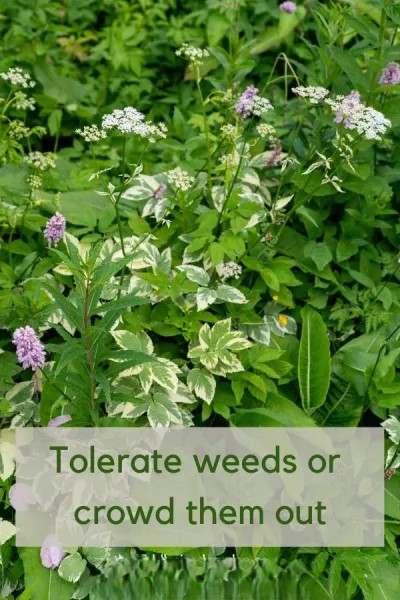
Another advantage of planting ‘thugs’ is that they don’t need cosseting. They’ll usually withstand droughts and rainy spells without the need for watering. But if you are watering, here are Garden Watering Strategies – How to Save Time, Effort & Money when watering your garden.
Use Bold Hedges to Add Structure
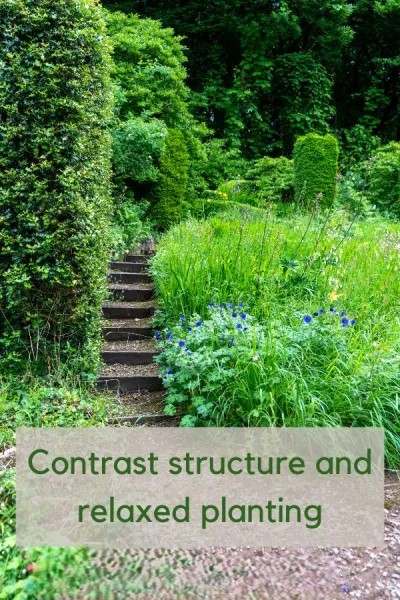
One of the reasons why Anne and Charles’s relaxed planting works so well is that it is combined with a strong structure.
The garden at Veddw is divided into room with chunky clipped hedges. The hedges make a pattern as they go down the hill.
Anne and Charles have maximised the impact of the hill and the hedges by creating a reflective pool, which mirrors the hedges.
Hedges are relatively low maintenance as they will only need trimming once or twice a year.
Try beech, yew, or hornbeam. They’re easy to trim once or twice a year. Avoid planting yew in soggy soil—it doesn’t like sitting in water.
Balance Wildness with Structure 2: Paths, Benches & Ornaments
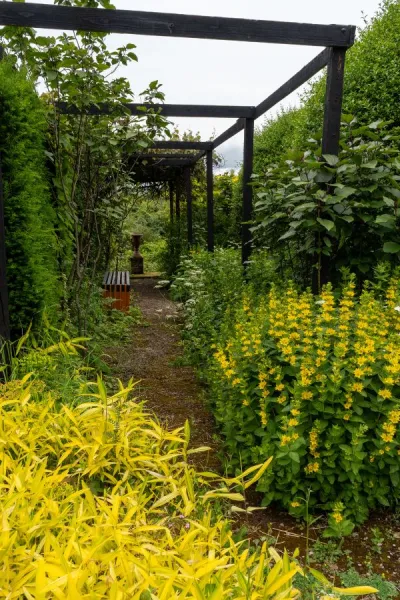
Paths, benchs and sculpture also create structure to balance wildness.
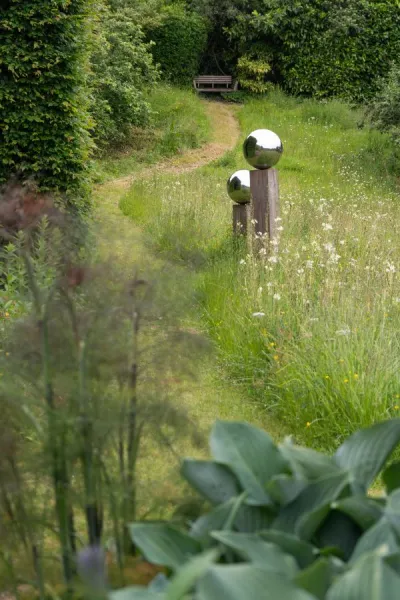
Anne and Charles created their paths with ‘gravel to dust’ from a local quarry. This is also called ’20mm to dust’, ‘crush and run’ and other names. It’s the smallest size of gravel, some of which is only dust.
The dust from the local quarry mixes with their local clay soil. After a few months, the path is hardened by rain and footfall.
They also designed their own benches. There is a bench as a focal point in almost every ‘garden room’. They vary from plain wooden benches in the meadow to the dramatic orange benches made of breeze blocks and timber.
Skip the Big Autumn or Early Spring Clear-up
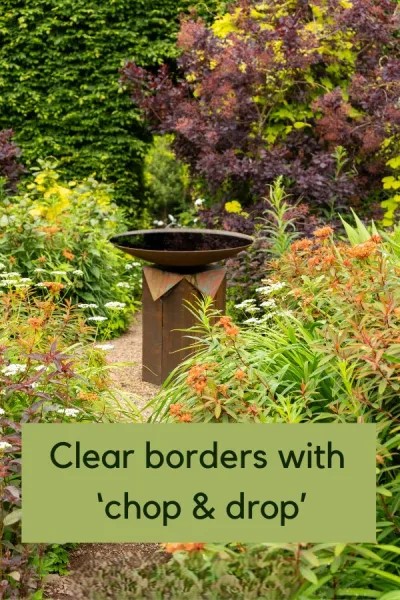
Anne says that she has never seen the point of clearing your borders in the autumn and dragging the cut material to the compost heap. ‘Then when it’s rotted down, you take it back again to spread on the border as compost,’ she says.
Instead she does chop and drop.
Cut down faded growth with shears, a strimmer or hedge trimmers in autumn or early spring. You can slice it down in several lengths.
Then simply leave it in place as a mulch. It will feed the soil and reduce watering.
Say No to Garden Edging
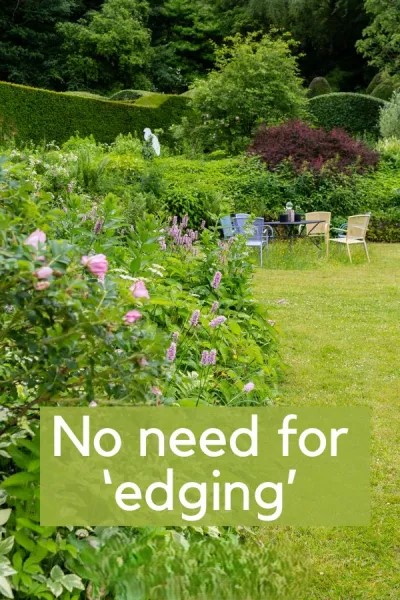
Anne also consider it unnecessary to edge lawns. ‘It’s not just the work involved in chopping a neat edge to your lawn or border,’ she says. ‘I like plants to flow into each other, not be divided by a sharp line.’
They grow resilient plants like alchemilla mollis on the edges of their borders. You can mow right up to them.
Anne also consider it unnecessary to edge lawns. ‘It’s not just the work involved in chopping a neat edge to your lawn or border,’ she says. ‘I like plants to flow into each other, not be divided by a sharp line.’
They grow resilient plants like alchemilla mollis on the edges of their borders. You can mow right up to them.
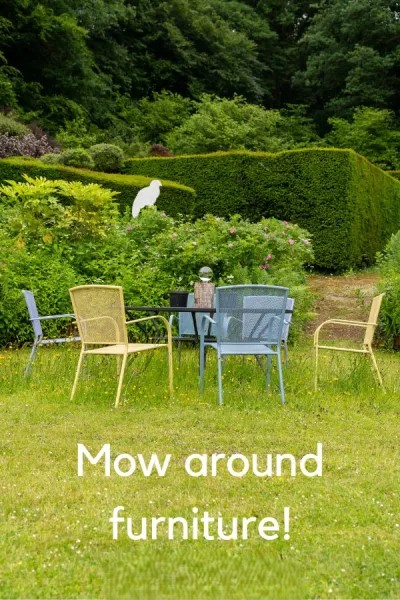
Make mowing easy
When Charles mows the lawn, he doesn’t always bother to move the chairs and table. He just mows round them.
It looks charming. And because the flowers are weeds, there’s no need to worry about trampling them if you want to sit at the table.
Let Ivy Grow Up Walls
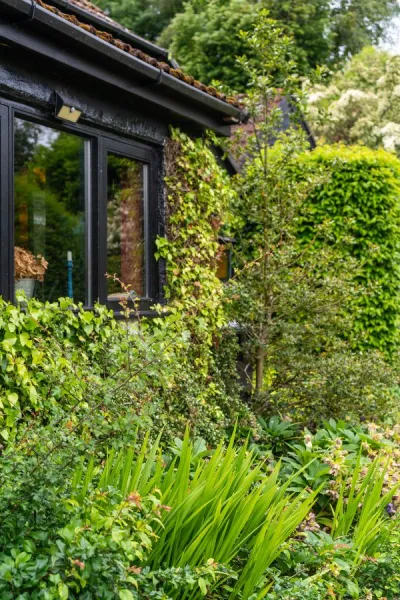
Ivy doesn’t damage walls if managed correctly. It can keep your house warmer and gives your garden a romantic, classic feel.
Just trim it regularly like a hedge and let it be.
The Royal Horticultural Society says that ‘in most cases, ivy doesn’t cause any damage to the building and fences it grows on and it can be maintained at a modest and manageable size to boost the biodiversity of your garden.’
Ivy won’t damage walls that are in good condition, but the roots can penetrate cracked walls. And if you let it wrap itself round your guttering, a high wind may bring it down. Anne trims their ivy once a year and enjoys the insulation and the wildlife benefits.
‘The roots are in the ground,’ she says. ‘But the ivy attaches itself to the wall with little pads and those can leave marks when you pull the ivy off. So once you’ve started to grow ivy up your walls, it’s a good idea to continue with it.’
Make it your own low maintenance garden style
A garden evolves. Notice which combinations work and what jobs don’t seem to be necessary in your garden.
For example, I used to see aphids on my roses every June. Sometimes I didn’t get round to washing them off. Then I’d realise they were gone anyway.
And that made sense when I interviewed Neil Miller, head gardener at Hever Castle, on Growing Roses. He says that they don’t spray their 4,000 roses against aphids. In the summer, the birds will pick them off for them.
So I noticed that if I left aphids on my dahlias, the same happened.
Finding out what works and what doesn’t can add to the pleasure you have in your garden without adding to the work.
Observe your garden. And most importantly, enjoy it.
We genuinely hope that you found our article helpful,Happy Reading!
