
Growing the Future: 4 Innovative Gardening Ideas To Transform Your Garden
I’ve just visited the Horniman Museum & Gardens in South London to talk to Head of Horticulture, Errol Fernandes, about their innovative gardening ideas and techniques.
These new ways of gardening are all about working with your garden and climate rather than battling to impose a set definition of what constitutes a beautiful garden.
This isn’t about ‘no work gardening’ (that doesn’t exist!). But this approach is an easier, more eco-friendly way of getting the best out of your garden, your soil and your climate.
And if you are facing challenges such as changing weather patterns or want to support wildlife better, here are some useful lessons.
The Horniman Museum was set up by its founder, Frederick Horniman, to ‘bring the world to South London.’
So they take a global approach, looking for ideas and techniques from around the world that can solve problems in our gardens today. This is a museum and gardens for the future – not just a collection of things from the past.
Formerly senior gardener at the National Trust’s Kenwood House, Errol’s background in Fine Art (he worked on projects with Tate and V&A museums) gives him an ideal perspective on how to combine gardening with museum curation.
He’s also a sought-after speaker on innovative gardening ideas (The Gardens Trust, The Garden Museum, The Beth Chatto Symposium) as well as being a TV presenter. And he is also a champion of gardening in a more sustainable way.
Four of the most innovative gardening ideas
The four new ideas are a micro-forest, a Xerophytic (low water use) garden, new techniques for cutting down ornamental grasses over winter and sorting out re-plant disease in their classic Sunken Garden borders.
As you come in the gates, you’ll see the sand, gravel and sculptural plant shapes of the Xerophytic Garden. If you are struggling to garden in a new-build estate or a soil full of rocks or rubble, consider this as a striking and beautiful alternative to a traditional garden.
Or turn the other way and walk toward the micro-forest. Hundreds of tiny young saplings were planted together to form a pollution-beating, noise-softening barrier against the busy main road. This can be done in a surprisingly small area, although it is more of an idea for middle-sized or larger gardens.
Look up towards the Prairie Garden where you may be in time to spot the unusual way they tie up their grasses and seedheads in spring. It looks like art – but it’s wildlife-friendly management!
Then stroll up to the Sunken Garden, where classic mixed borders used to be changed several times a year, depleting the soil and causing replant disease. Now the borders are still vibrant with colour but they are also wildlife-friendly and healthy. By using perennials and wildflowers, Errol has allowed the soil to recover its health. It also means less work for the gardening team.
What is the Japanese micro forest method?
Many innovative gardening ideas come from Japan. The micro forest technique is also also known as Miyawaki, says Errol.
‘In the 1970s, Akira Miyawaki, a Japanese botanist and ecological expert, was observing naturalised forests. He saw that trees grew where seed had fallen, often in very close proximity to one another.’
Miyawaki saw that a dense thicket would grow up, creating a closed canopy in as little as three to five years. So he developed a method of planting lots of very young saplings close together.
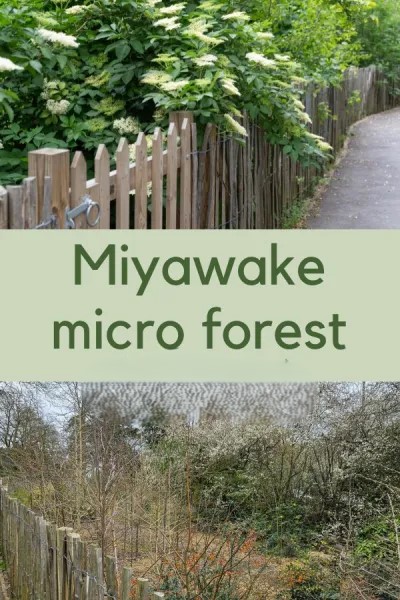
The intensive way these trees grow means that these trees will absorb more carbon and pollution than normal trees. A micro forest also needs less maintenance than a hedge, because you don’t clip or prune it. The close planting restricts the growth of the trees.
The project was funded by a public campaign. Errol’s team planted 900 trees – in 35 different species – in 400 square metres. ‘Miyawaki himself championed what he called PNV (Potential Natural Vegetation),’ says Errol. Essentially that means planting native species of trees.
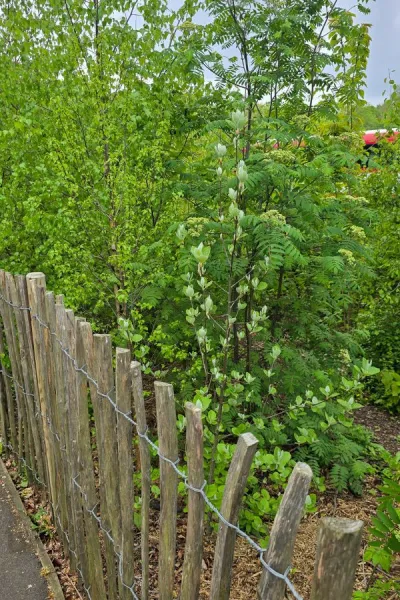
But with the Horniman’s climate and ecology manifesto at the heart of everything they do, Errol decided that it was also important to include tree varieties that could cope with extreme weather conditions or a changing climate.
‘Even sporadic changes in weather – sometimes it’s intensely wet, cold or dry – can affect plants badly, so we planted a range of both native and non-native trees.’
A wider range of native and non-native trees also supports a broader range of wildlife.
How to plant a Miyawaki micro forest
‘Plant very young trees, all the same age – at pencil thickness and pencil height,’ Errol explains.’We planted them just 40cm/50cm apart. They compete with each other at first, but then they start romping away and become an eco-system.’
‘We’re now in the third year and some of the trees are 15ft high, which is staggering when you think that creating a forest is usually a long term project.’
Errol thinks that you could plant a micro-forest in an area as small as 3m x 3m (approx 10ft x 10ft). ‘The key is that by planting them so close together, they keep each other in check,’ he says. ‘They’ll never grow to the full height of that the individual trees would.
The important thing is that you must NOT prune these trees. ‘You make your selection and you plant them, and it’s “hands off” after that,’ says Errol.
‘The main maintenance we did was to add a layer of straw-based mulch after planting so that weeds didn’t grow up and crowd out the young trees.’ It would be very difficult to weed such a tightly planted area and you certainly couldn’t strim.
‘Think of it as a native hedge, but without the pruning,’ he says.
A wildlife-friendly way to tidy up after winter!
The Horniman’s Prairie Garden, created with James Hitchmough in 2018, features North American and South African grasses. A gravel layer helps protect the plant crowns from winter rot by improving drainage.
Errol’s key change has been how the grasses are maintained.
Most gardeners now agree that grasses and perennials can be left standing over winter for their sculptural beauty. More importantly, they provide food and shelter for birds and insects. Hollow stems hold overwintering invertebrates like ladybirds. They can’t survive if the grasses are cleared too early.
However, the Horniman can’t allow the grasses to die down naturally as they would create a layer of decomposing vegetation. This would ultimately create a soil layer over the plant crowns.
So they need to cut them back in early spring, when most invertebrates are still hibernating. So instead of composting the cut grasses immediately, Errol ties them into sculptural bundles on hazel posts. This allows insects time to emerge into warmer weather. These bundles are composted in June, when wildlife has moved on—combining neatness with nature-friendliness.
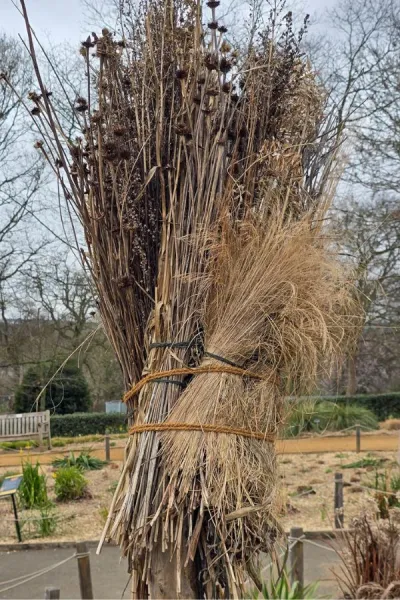
If you want to be wildlife friendly and tidy your garden in winter, then Errol says you could tie dried grasses on hazel posts, in ornamental and sculptural shapes. ‘We choose hazel because it takes a long time to rot down,’ explains Errol. ‘Or you could make a teepee with hazel sticks and cram that full with cut grasses and hollow stems.’
In How to Garden For Biodiversity, the wildlife garden at RHS Wisley has a slatted wooden sculpture. This is stuffed with grasses and seedheads from autumn onwards.
‘It can look almost as if a witch has tied up her broom,’ says Errol. Any remaining seeds can be eaten by the birds, who also use the straw for their nests.
Innovative gardening ideas for traditional borders
The traditional bedding displays in the Sunken Garden were changed two to three times a year, which was high-maintenance, costly, and hard on the soil. Constant replanting depleted nutrients and encouraged replant disease. Errol and the team shifted to a more sustainable, low-maintenance approach.
Over three years, they replaced most bedding with perennials and shrubs, linking plant choices to the museum’s ‘Birds & Invertebrates’ exhibits. They focused on species that support wildlife through food or habitat.
Tulips are now planted deeply (8–9 inches), which helps them return each year. These are paired with self-seeding forget-me-nots for colour with minimal effort. (Myosotis sylvatica). These come up every spring as a brilliant blue foil to the tulips. It really looks stunning. The only work you may need to do is to pull out some of the forget-me-nots every year as they can spread very quickly.
Crab apple and rowan trees add height, blossom, and berries.
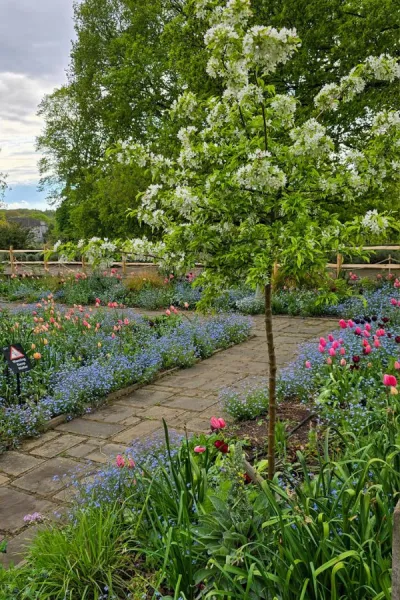
To rest the soil, they sowed wildflower seeds for two years. They didn’t dig them up at the end of the year. After flowering, the wildflowers were scythed to the ground. So there was very little disturbance to the soil. This allows it to regenerate naturally.
These wildflowers (and the forget-me-nots) self-seed to fill gaps. Instead of replanting annuals in summer, the team simply ‘edits’ them to manage the mix.
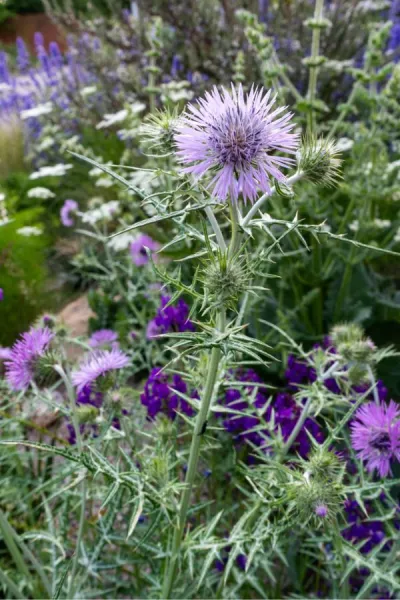
Shrubs and perennials were reintroduced for structure and sustainability. Roses like Rosa glauca and Rosa mutabilis provide low-maintenance beauty and wildlife value. Perennials now include Benton irises, cardoons, and smokebush. You’ll be doing less digging and achieving greater biodiversity.
Three top tips for less work and more biodiversity in your borders
- Plant bulbs deeply. They’re more likely to come back. You can top up the gaps.
- Use wildflowers and self-sowers to fill gaps. They minimise both digging and cost.
- Perennials, shrubs and trees are less work and often more useful for wildlife than annual bedding plants.

Another garden that combines beautiful borders with wildlife friendly and environmentally sustainable principles is Great Dixter.
What to do with dry, rocky soil… xerophytic (low water use) plants
If you live in a town, city or new-build area, the chances are that your soil will have rubble, bricks or pavers either from building or from previous garden incarnations.
And if you’re doing any building work or replacing a terrace, you will have to pay to send old construction material to landfill.
The Horniman launched its Climate & Ecology manifesto in 2020. This underpins all their work in both museum and gardens.
Their south facing borders at the front of the museum needed renovating. It’s potentially a hot dry area. Sunlight bounces off the sandstone and heats the area in front of it. So it made sense to plant plants which were resilient, especially in drought.
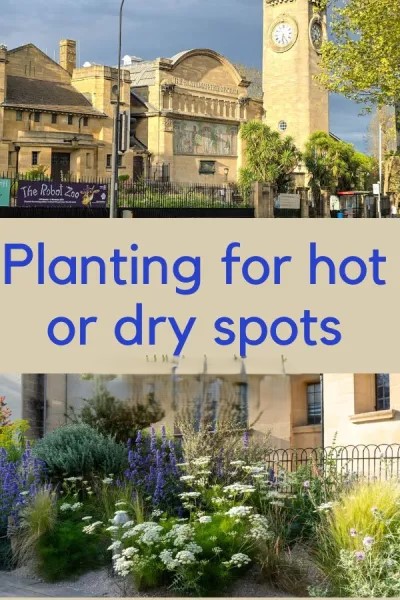
And they had a big pathway project in the garden, re-laying the paths. ‘There was about 15 tons of sub-base, that would normally have gone to landfill.’ So they had it crushed. (You can hire a concrete crusher.)
They dug trenches and filled it first with the bigger pieces of concrete – ‘big concrete boulders, essentially.’ Then they added the rest of the sub-base spoils and topped it off with gravel and sand.
This creates a border with very good drainage. Many plants can cope with surprisingly low temperatures but not with winter wet. They die in winter, not because of the cold, but because of their roots sitting in damp, cold soil.
Xerophytic means ‘low water use’ gardening. Almost all plants need watering until they are established, so Errol’s team does water them all in their first season.
Happy Reading!
