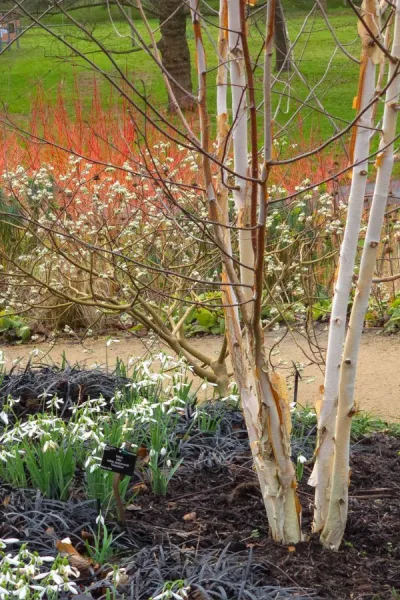
Brilliant plants for vibrant winter colour and scent
I recently visited Kew Gardens’ new Winter Garden and was blown away by the winter colour and scent.
Even though Kew Gardens is one of the leading botanic gardens in the world, I wasn’t expecting to see anything in the gardens at this time of year. I had gone to see an exhibition with my daughter. But we were both entranced by the new Winter Garden, which is recently planted.
It’s not a large space, but the plants are brilliantly chosen and combined to create winter colour and scent when most gardens are grey and dreary.
The plants are widely available and the way they’re put together would work well in most gardens.
Making the most of the slope – an immersive garden layout
Firstly, they’ve made a contemporary use of a slope.
The Winter Garden is on a small hill that used to have flagpoles. Now a wide curved path winds up a gentle hill and down again on the other side.
A path winding across a slope is an immersive way to plant on a slope because you have the sense of walking through the planting. It’s an approach that works very well at the new Oudolf Landscape borders at RHS Wisley.
Some of it has just been planted and hasn’t filled out yet. But other areas were a blaze of colour, texture and fragrance.
There were dates on the plant labels to show when they were planted. This is useful because it gives us an idea of how long it would take to achieve the rich tapestry effect you can see today. The Winter Garden is only two years old, so that shows you can create a reasonably immediate impact.
The planting was a mix of stand-out plants and clever combinations.
Winter trees and shrubs for bark colour and structure
Let’s start with the trees.
They were almost all deciduous, meaning that they lose their leaves in winter. That gives bark and sculptural shape.
You don’t need evergreen trees and shrubs for winter colour!
Interestingly, there were no evergreen trees in this Winter Garden, although there were a few just beyond it.
There were some evergreen shrubs, but not many.
There’s an assumption that you need evergreen trees and shrubs for winter colour and impact. You can certainly create a beautiful year-round garden with evergreens, as you can see in A Clever Evergreen Garden with a Touch of Grandeur.
However the Winter Garden at Kew shows that deciduous trees and shrubs, which lose their leaves in winter, can add more winter colour than any evergreen!
Prune them for a sculptural shapes and choose them for the colour of their bark.
At the entrance to the path there are some established trees, beautifully pruned to frame the borders. If you’re getting trees pruned it’s really worth finding a good tree surgeon and discussing what you want with them.
Choose specimen trees for winter colour with bark
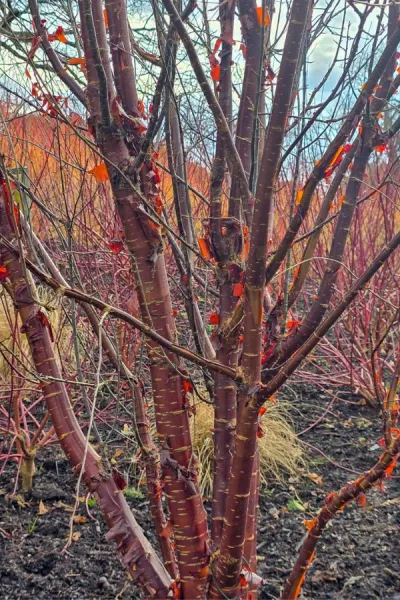
Then there were some standalone specimen trees with interesting bark such as Prunus Serrula ‘Tibetica’ (Tibetan Cherry) planted so that the morning sun lights up its peeling bark.
Group trees for a contemporary forest effect
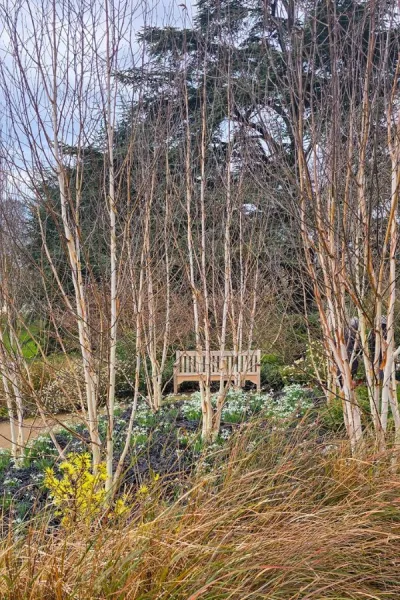
And there were groupings of Himalayan birch ‘Jacquemontii’ with their white bark creating ghostly outlines. This must be the ultimate winter tree.
Shrubs for winter colour
Shrubs are plants with a woody stem that stays above ground all year.
You might expect ‘shrubs for winter colour’ to be evergreens with interesting coloured leaves. But no! The shrubs in the Kew Winter Garden were a blaze of colour because of their stems.
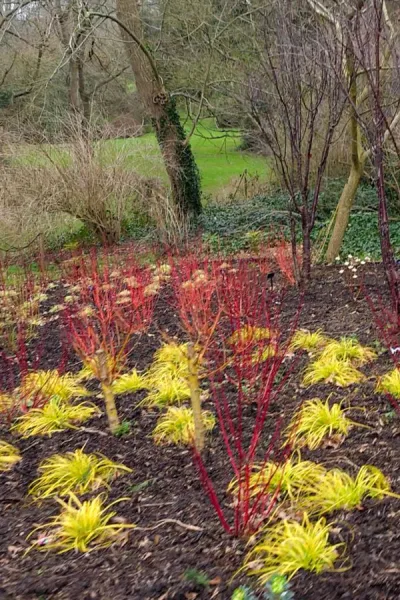
The most famous coloured stem shrubs are Cornus, and there were several different types at Kew. Grouped together the bare winter stems blaze like a fire in dark red, bright orange and green.
Clever combinations and contrasts
The Cornus also made good contrasts with two different shades of Hakenochloa macra or Japanese forest grass. Much of this area will be quite shady in summer, and most of these plants are woodland edge shade lovers. But the cornus need a little more sun to get their vibrant stem colour, so note that they are planted where they won’t be too shaded.
Beautiful winter-flowering bulbs and perennials
The combination of bulbs and perennials in Kew’s Winter Garden was a master class in planting.
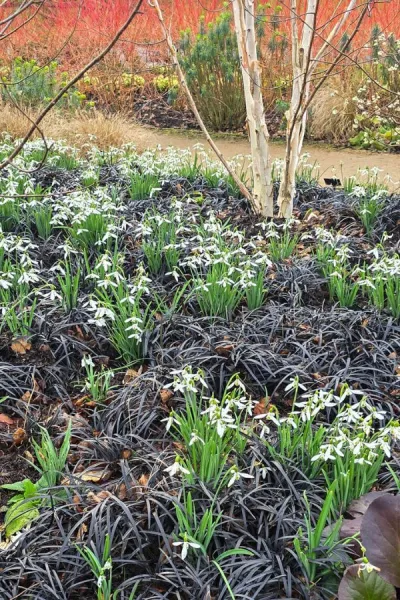
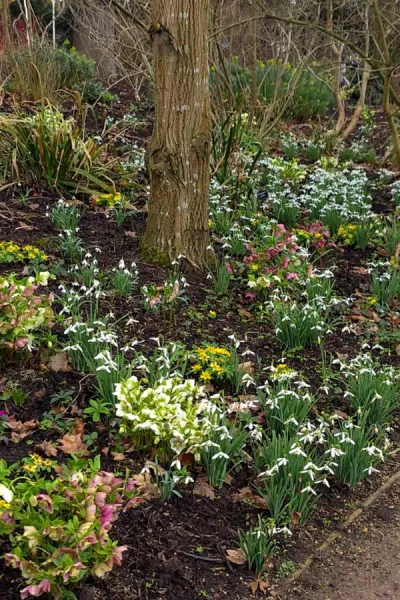
I absolutely loved a patch of snowdrops with Black Mondo, a black grass variety called Ophiopogon. The snowdrops also worked brilliantly with the hellebores, especially a white hellebore called Christmas Carol.
Because the garden’s so new, some of the clumps have yet to fill in, but you can also see how well yellow winter aconites work with the snowdrops. Most of these snowdrops are the taller varieties, which may be a factor in why these groupings look so good.
And there are some ornamental grasses too, which have lost their colour but look graceful waving in the wind.
Clever combinations and contrasts
Best scented winter plants
The Kew Winter Garden features several of the best plants for winter scent. They were planted close to the path, at intervals.
So we were greeted by a waft of gorgeous fragrance as we walked up the path. These are all easy-care shrubs. If you plant them at home, plant them near to where you’ll walk.
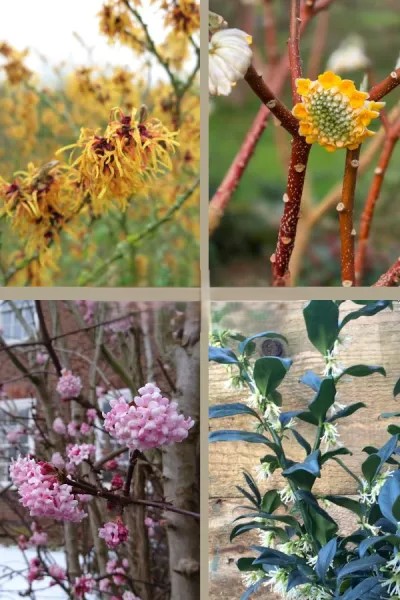
Christmas box (Sarcocca confusa)
A good shade-loving shrub with delicate white scented flowers. It is hardy to around minus 20C/minus 5F and is drought tolerant once established. (Most drought-tolerant plants do need watering in their first summer until they get their roots established.) It’s tolerant of most soils and easy to grow.
Arrowwood ‘Dawn’ (Viburnum x bodnantense ‘Dawn’)
This has charming pink flowers which bloom all winter in mild climates, such as the UK. In colder climates, it blooms from late winter to early spring, and it is hardy down to around minus 26Cminus 15F.
I have a Viburnum ‘Dawn’ in my front garden, close to the fence. Passersby often comment on the glorious sweet scent.
Paperbush ‘Grandiflora’ (Edgeworthia chrysantha Grandiflora)
This is a new shrub for me. It’s instantly striking with its yellow and white flowers on bare stems in winter. It needs full sun or partial shade. And it’s hardy down to around minus 15C/5F.
‘Grandiflora’ means ‘big flowers’ so the shrubs planted at Kew are the larger variety. However, they were still quite compact. The shrubs we saw were about 3ft high, but they can grow to 6ft apparently. This Winter Garden at Kew is very recently planted, so many of the plants may not have reached their mature height.
My friends The Horti_Culturalists have recently done a YouTube video on How to Grow Edgeworthia, so if you want to grow it, take a look. It’s generally easy-care and doesn’t suffer from any particular pests or diseases.
Witch hazel (Hamamelis)
There were several witch hazels at Kew, including the well-known ‘Jelena.’ Witch hazels look delicately beautiful and have a divine scent, but they are very hardy, surviving temperatures down to around minus 40C/minus 40F. They’re also quite flexible about sun and shade.
This new Winter Garden at Kew will go on getting better every winter. I can’t wait to go back next year!
