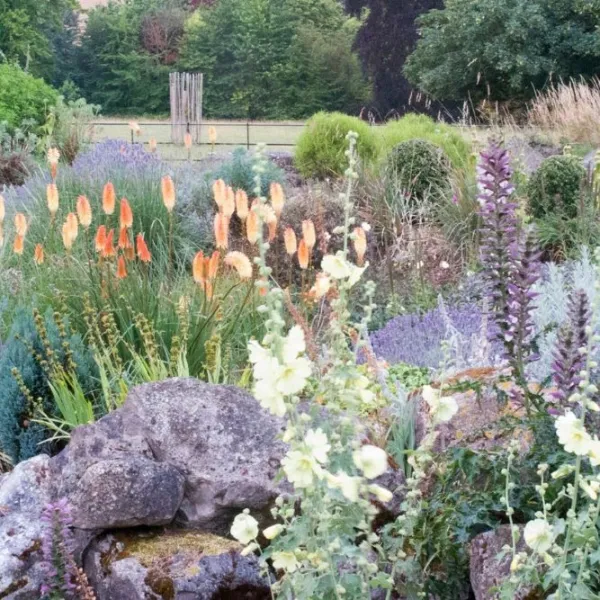
The rock garden is back – and it’s drought tolerant and low maintenance
A rock garden – often called a ‘rockery’ – was once an essential element in both grand and smaller British gardens.
Then they got too popular. Banks of stones and rocks were added to almost any garden, without any real thought or understanding. And then they were neglected. People stopped caring about rock gardens.
And so the rockery almost disappeared from the 21st century garden designer’s palette.
But a few years ago, garden centres began to report increasing sales of rocks and alpine plants.
The Guardian newspaper predicted that a ‘rockery revival’ was underway. Rocks, pebble mulches and gravel gardens started to appear at the garden shows, such as Amanda Grimes’ ‘Punk Rockery’ garden at RHS Hampton Court last year.
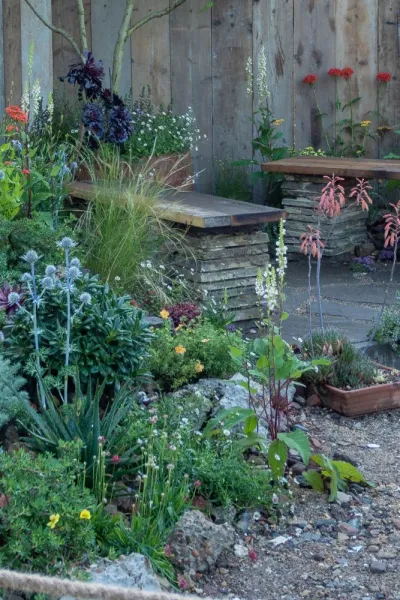
So I talked to Amicia Oldfield of Doddington Place Gardens, which was short-listed for Historic Houses Garden of the Year last year. It has a superb rock garden, dating back to Edwardian times and renovated 12 years ago.
While the herbaceous borders had to be irrigated in the UK’s record-breaking drought and heat summers of 2022 and 23, the rock garden has never needed watering.
It’s quite large – around half an acre, set in ten acre gardens, but there is inspiration there for our own smaller rock garden areas. You can visit Doddington Place Gardens between April and September. It’s open to the public twice a week.
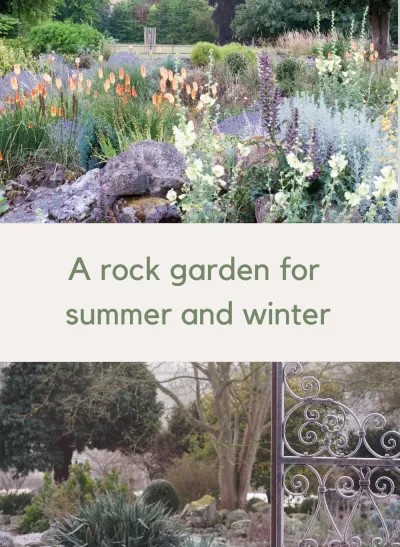
How to plan your rock garden
Amicia suggests that you start by visiting other rock gardens. If they’re in major gardens, such as Doddington Place Gardens, they will be on a much larger scale, but you can still take ideas from them.
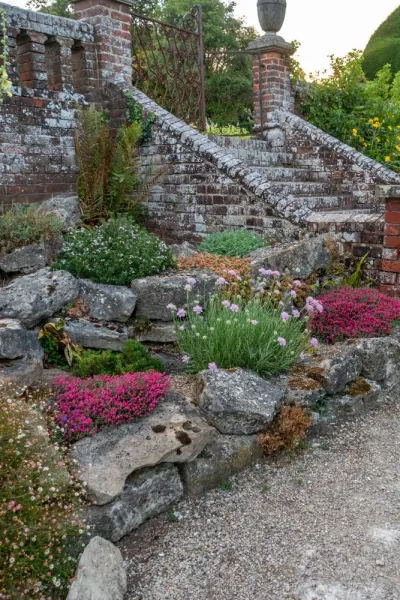
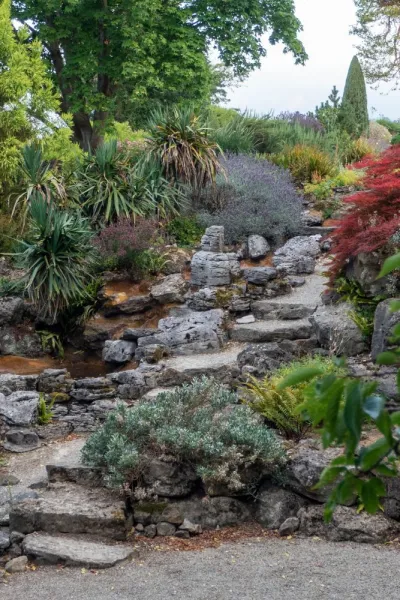
And Amicia also suggests looking at a small section of a bigger rock garden. There’s an area with alpine plants just by Doddington Place Garden’s steps that would translate beautifully into a small town garden, for example.
You can also look at Instagram, Pinterest and other social media platforms, using the hashtag #rockgarden or #rockery. Not all will necessarily be ideal examples of rock gardens, but it will help you decide what you like and what you want to avoid.
Where to place your rock garden?
If you have a sunny slope in your garden, then a rock garden is the perfect solution.
Even a small bank can be difficult to plant or water if you want to plant it up conventionally. And it’s often cheaper than putting up a retaining wall or terracing the space.
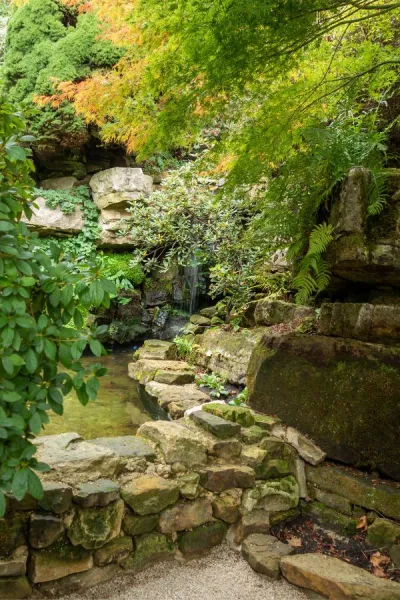
But you don’t necessarily have to have a slope in your garden.
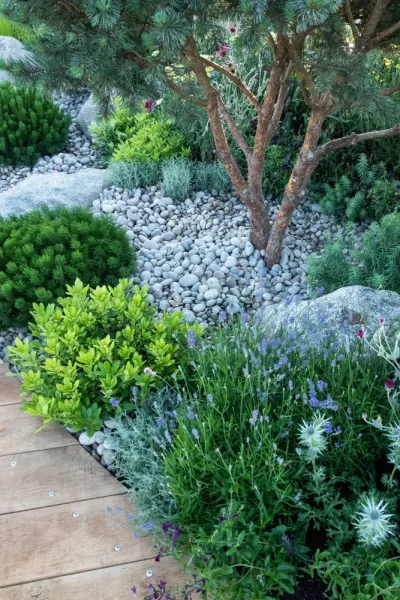
Measure out the space and decide how many rocks you need. You can either pack rocks closely together or space them out, separated by a pebble mulch or gravel.
Add rocks or boulders to your garden to create height
Garden designer Posy Gentles created a rock garden in her long, narrow town garden in order to create more height in an area. Posy was given the rocks by someone who wanted to get rid of them.
So if, like Posy, you’ve acquired rocks free through one of the online exchange forums, then the size of the rock garden will probably be dictated by how many rocks you’ve got.
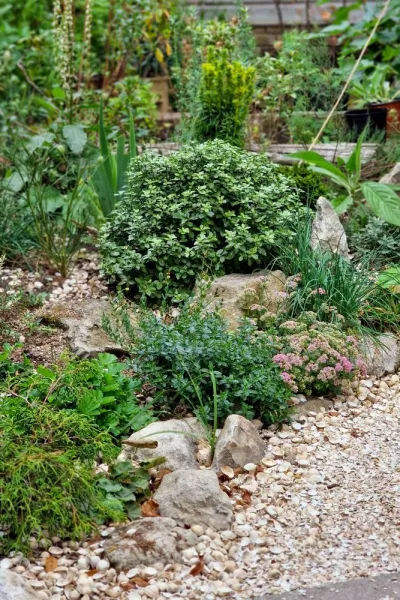
Use larger rocks or boulders in a flat area to create height. This will help you showcase smaller plants, because you’re lifting them up.
Typically rock plants or alpine plants are shorter because they have to withstand the winds of a mountain terrain.
How to choose the rocks
Research your local stone, as that will look more natural in your landscape.
You may not be aware of what your local stone looks like, but an internet search will quickly throw up huge differences between -for example – smooth Scottish pebbles, rugged Welsh slate and creamy Cotswold stone. It’s likely that at least some buildings in your area will be made of local stone.
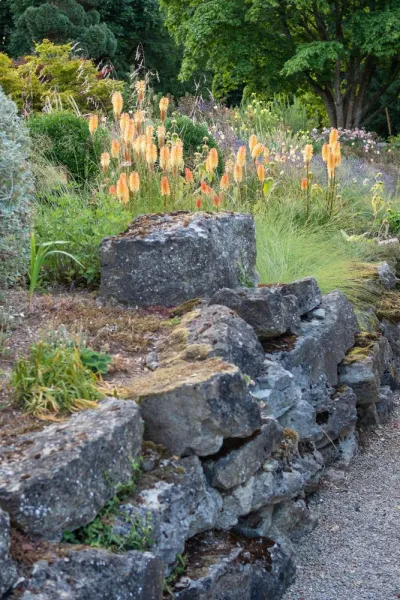
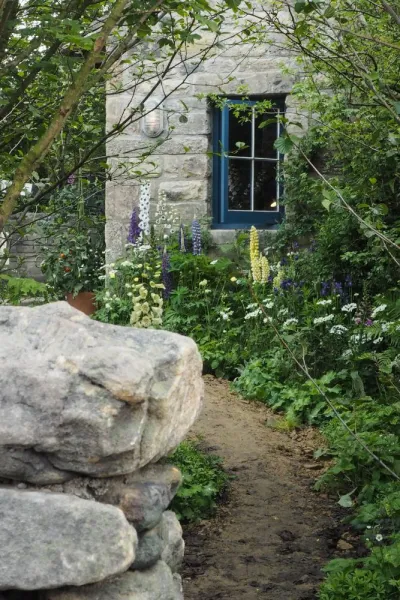
Put ‘buy stone rocks near me’ into a search engine and lots of options will come up.
Rocks can be expensive to buy, but there are also options for getting them free and second-hand. Posy Gentles suggests you try local marketplaces, such as Freecycle, Freegle or Facebook Marketplace to look for people who want to get rid of rocks in their gardens. ‘You can often get them for free if you collect them,’ she says.
Of course, buying or obtaining rocks locally won’t guarantee that they’re local rocks. However, if you’ve done some research, you’ll have a good idea of what would look most appropriate.
Let the rocks develop a patina of age – don’t clean moss or lichens off them. Both are important to the eco-system and give your rock garden a natural look.
How do you arrange rocks in a rock garden?
The RHS says that stones should be buried at about a third of their depth, tilting backwards to mimic how they would emerge from the landscape naturally.
If you’re constructing a slope then you can use a pile of brick, stone or rubble as a base. The RHS suggests covering with upturned turf before adding soil and compost. It stops the compost and soil from falling right down between the cracks of the rock.
Posy once worked at a garden where the owners bought a pile of bricks which they’d intended to use for a project. However, they never got around to it. Plants began to colonise the pile of bricks and it is now effectively a rock garden.
And Posy’s own rock garden only raises the level of the soil by about six inches, so you don’t need to create a cliff face.
Rock garden plants
- Set evergreen structure in place first, such as miniature conifers for vertical interest
- Add smaller evergreen shrubs for winter interest
- Find a supplier of alpines locally to you.
- Small, drought-tolerant plants such as sedums and sempervivums
- Trailing plants, such as creeping rosemary, creeping thyme or aubretia
- Add contrasting shapes, with spiky plants – iris, perovskia, yucca, knipfofia
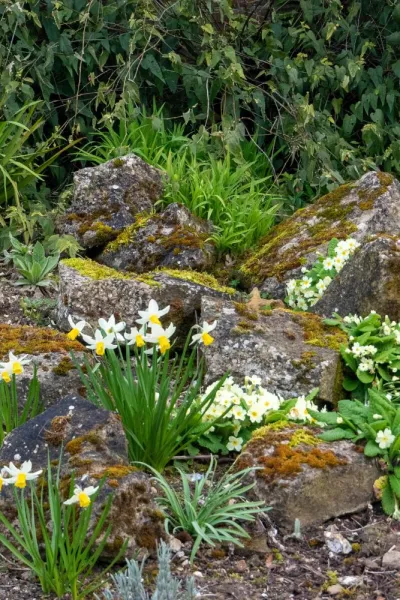
- Plant smaller bulbs (wild or species tulips, miniature daffodils, snowdrops, crocus, muscari)
How to plant a rock garden
Start with the evergreen structure.
Traditional rock gardens mimic an alpine mountainside. Plants are usually small, to survive rugged mountain conditions and strong winds. But you also need some vertical presence.
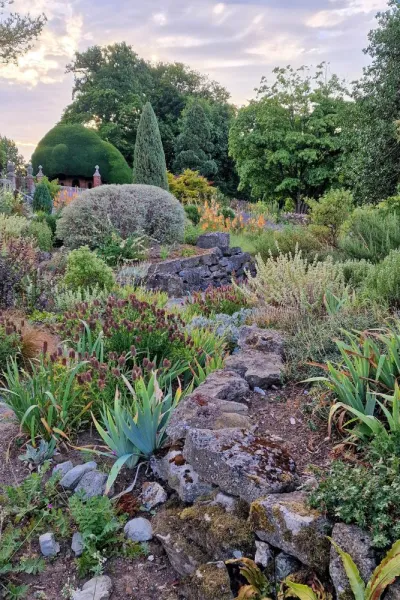
Miniature conifers come with good shapes and leaf colours, but the RHS warns that you should check that they are ‘miniature’ rather than dwarf, as dwarf conifers are often very slow-growing but may eventually get too big for the space. Check the final size of shrubs too, to see they won’t outgrow the space.
Rock gardens partly evolved to display alpine plants. Look for a supplier of alpine plants in your area and ask their advice on which ones are best in your climate or soil. Many garden centres also have an alpine plants section.
Many other smaller, drought-tolerant plants also work well. Sedums (stonecrops), sempervivums and other succulents are particularly good, but check which ones will survive your winters.
The plants in 15 drought tolerant plants that will also be happy if it rains will also be good in rock gardens.
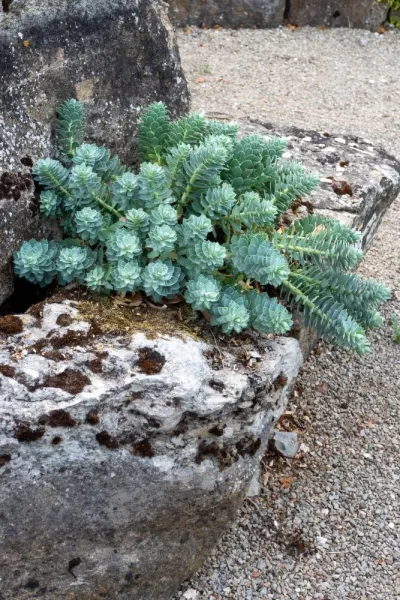
Rock gardens make good use of vertical space so remember to include both spiky plants and trailing plants.
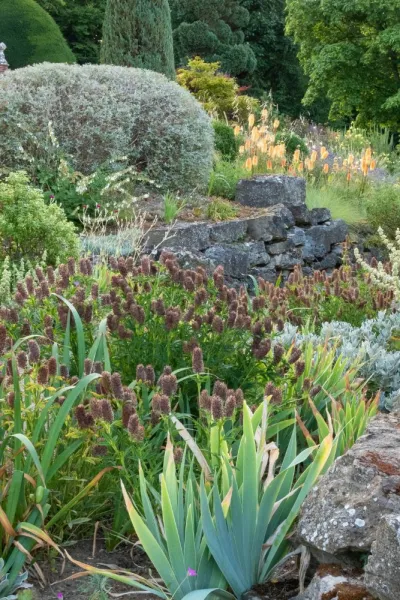
Many original bulb species came from mountainous places. So smaller bulbs, such as wild tulips and miniature or species daffodils look good in rock gardens. You can also plant full size bulbs.
Sculpture and water features in rock gardens
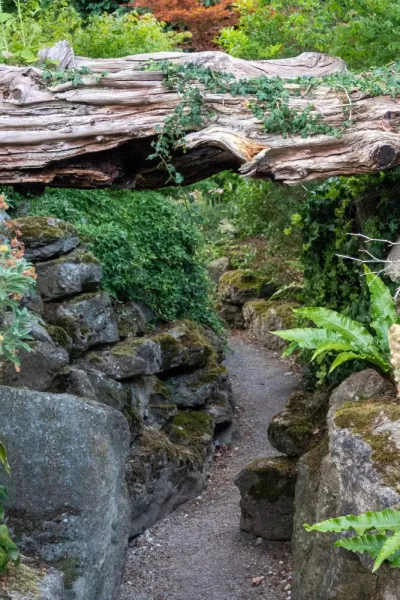
Both Amicia and Posy think there is already enough shape, structure and interest in a rock garden. It doesn’t need sculpture. But use the sculptural shapes of nature. At Doddington Place Gardens, interesting rocks and fallen trees create wonderful sculptural shapes.
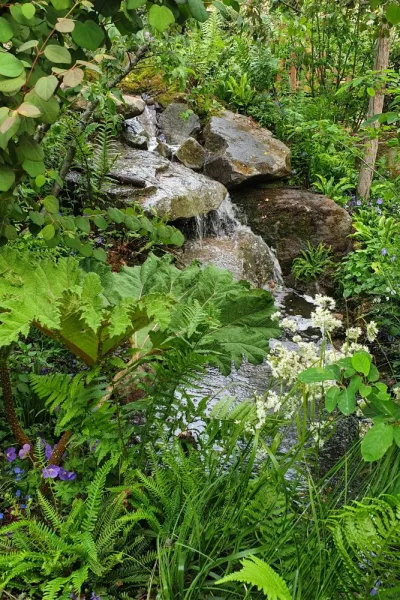
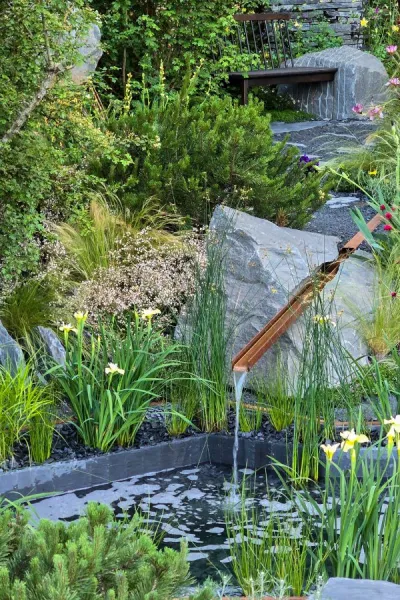
A waterfall is a natural choice for a water feature. This is in the woodland garden designed by Davies & White with the Duchess of Cambridge at the RHS Chelsea Flower show.
And rock gardens use water in other ways too. There is usually a pond or water feature in a zen rock garden .
And traditional rock gardens, such as the one at Doddington Place, often have a waterfall leading down to a pond.
Do you need a weed suppressant membrane under stones, sand or pebbles?
You will often be advised to include a weed suppressant membrane when putting together your rock garden. Don’t take this advice.
I belong to a number of professional gardener Facebook groups, where people discuss issues that come up in their work and share solutions. Recently a gardener was putting together a rockery for a client who wanted her to use a weed suppressant membrane. She asked the group’s opinion, and everyone, without exception, advised her against it. And it’s very rare to have everyone in agreement!
That’s because weeds grow on every garden surface, including weed suppressant membranes. And the roots of perennial weeds will find a way of wiggling around the sides, too. So after a few months, you will still have to weed.
But most importantly, weed suppressant membranes tend to ruck up, so they show, and that looks ugly.
Is a rock garden low maintenance?
There is some debate about whether a rock garden is low maintenance. If you choose the right plants, it is drought resistant. They have never had to water the rock garden at Doddington Place, for example.
The plants are usually compact and so don’t tend to get out of hand, nor do they frequently need replacing. Doddington Place’s rock garden was replanted over ten years ago, and most of those plants are still thriving.
However, some gardeners say that the open aspect of a rockery attracts more weeds than a crowded herbaceous border. You may have to weed more often. But if it’s not a large area, then that may not be a problem.
Zen rock gardens
Zen rock gardens are also known as Japanese dry gardens or Japanese rock gardens. These are minimalist areas where every element is carefully chosen and positioned. Zen rock gardens originally emerged from monasteries in Japan where they were an aid to meditation.
Today you can find hundreds of ‘zen’ ideas for planting with rocks, stones or gravel. Traditionally, Zen gardens would have been rich in symbolism. The central idea is that rocks have a special role in Zen philosophy as a symbol of the force of nature.
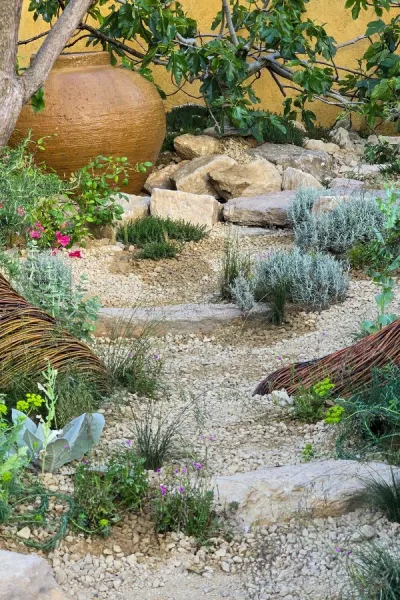
Most of today’s ‘zen garden ideas’ are more fashionable than spiritual. But there is respect for the idea of wabi-sabi (something unfinished or imperfect). So the stone and pebble paths are uneven or winding, the rock edges may be rugged or smooth and nothing is placed geometrically.
Traditional zen gardens were dry gardens with sand, but today there is often a water feature or a pool for contemplation. Designers have borrowed many of the elements of Zen gardens for today’s urban gardens, especially when they want to create an atmosphere of tranquillity.
Other solutions for planting on a slope
A rock garden is a brilliant solution for a sunny slope. But if you have a shady slope, especially if there are lots of trees, consider a stumpery.
